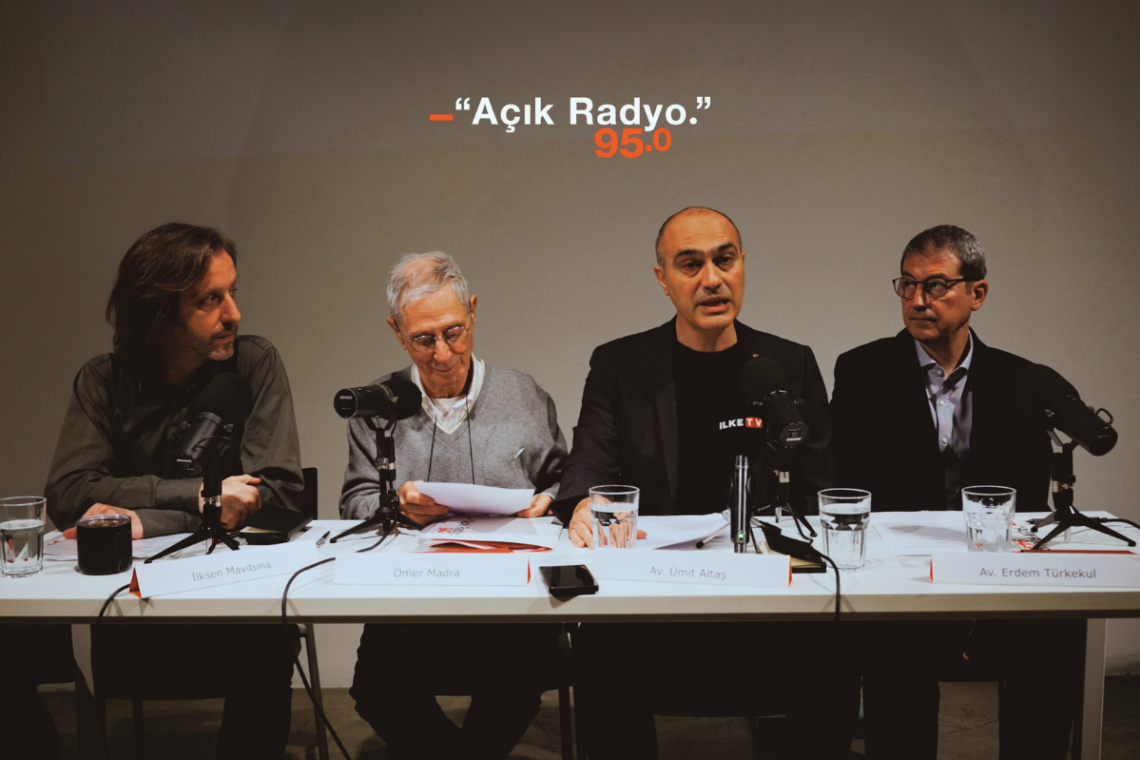
The judicial process regarding RTÜK’s cancellation of Açık Radyo’s broadcasting license has been brought to the Court of Cassation stage. Following rejection decisions by the court of first instance and the appellate court, the case file was submitted to the high court for appellate review.
At a press conference held in Istanbul, Açık Radyo and its legal team evaluated the process not merely as an administrative sanction issue, but as a case in which the boundaries of freedom of expression are being redrawn. In the statements made, it was emphasized that the decisions have the potential to create a broader impact in the media field.
Courts ‘limited freedom of expression according to the medium’
In the lawsuits filed, it was argued that the expression in question should be evaluated within the scope of freedom of expression, and that in a live broadcast format, the broadcaster cannot be held directly responsible for the statements of guests.
Despite this, the courts rejected the cases. In the reasoning of the decisions, it was stated that the expression used could be offensive to a segment of society. More notably, the courts adopted the view that while the same expression could be protected at the individual level, it could be evaluated differently when expressed through a broadcasting medium.
This assessment led to criticism that freedom of expression was being limited not according to its content, but according to the medium through which it was conveyed. In the case law of the European Court of Human Rights, however, it is accepted that freedom of expression should be interpreted broadly, especially when it concerns expressions that contribute to public debate.
Risk of ‘chilling effect’
In statements made at the press conference, it was emphasized that heavy sanctions such as license cancellation create a chilling effect that affects not only the relevant broadcaster but the entire media field.
It was stated that such interventions, which could lead to controversial or political topics finding less space in the media, indirectly restrict the public’s right to receive news.
The Açık Radyo case has once again brought to the agenda the question of at what point the supervision of broadcast content by administrative authorities turns into interference with freedom of expression in Turkey.
Broadcast continues digitally
Açık Radyo, whose terrestrial broadcasting ended with the license cancellation decision, has continued its broadcasting activities on digital platforms under the name “Apaçık Radyo.”
It is considered that the decision to be made by the Court of Cassation may set a precedent not only for this application, but also in terms of how the limits of freedom of expression in broadcasting in Turkey will be determined.