

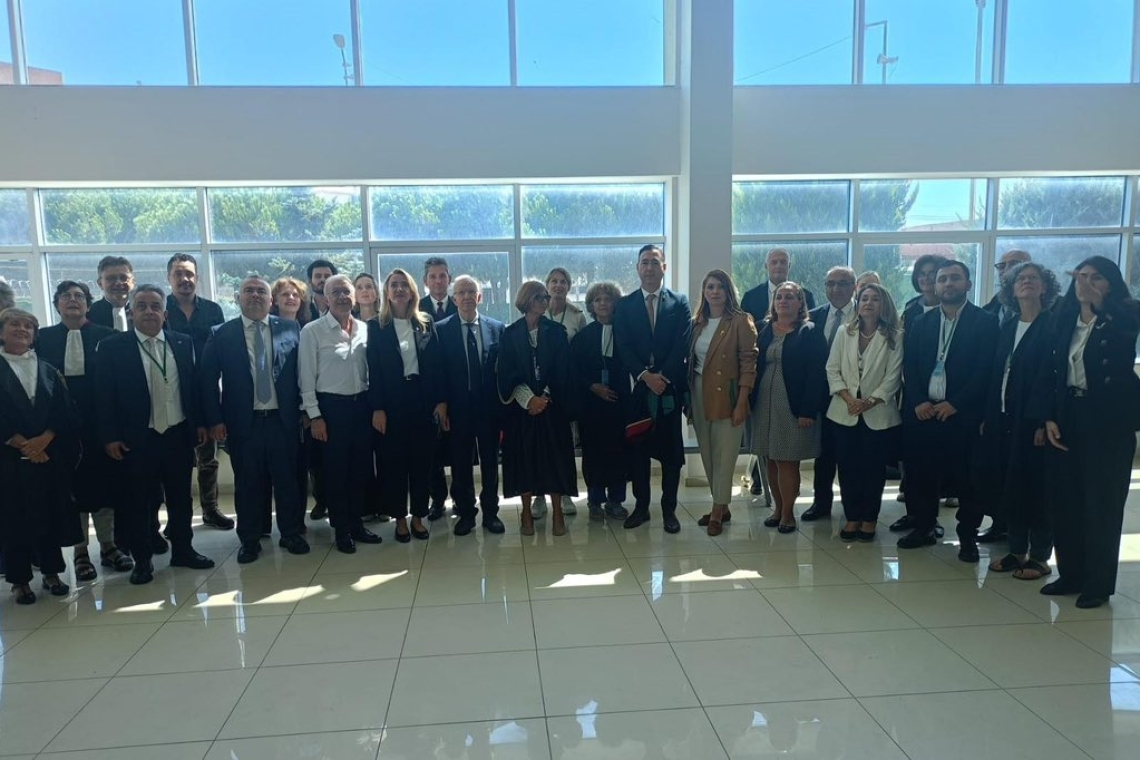
- In the case against executives of the Istanbul Bar Association, the court rejected the application claiming that Articles 7/2 of the Anti-Terror Law (TMK) and 217/A of the Turkish Penal Code (TCK) are unconstitutional. The trial continued inside the prison complex in Silivri, a town roughly 85 kilometers west of central Istanbul.
- The prosecutor accused the bar association’s statement regarding journalists Nazım Daştan and Cihan Bilgin of constituting “terrorist propaganda,” and requested punishment solely under Article 7/2 of the Anti-Terror Law. Bar Association executives and lawyers reacted to the hearing being held inside a prison complex, stating that “the right to a fair trial is being violated.
Semra Pelek
Bar Association executives on trial over humanitarian law statement
Istanbul Bar Association President İbrahim Özden Kaboğlu and the association’s board members are being tried on charges of “making terrorist propaganda” (TMK 7/2) and “publicly disseminating misleading information” (TCK 217/A), over their statement titled “Apply International Humanitarian Law,” issued after the deaths of journalists Nazım Daştan and Cihan Bilgin in Syria. The third hearing of the case was held at the Marmara Penal and Correctional Institutions complex in Silivri on Jan. 5.
The hearing began at 11 a.m. and was attended by Istanbul Bar Association President Prof. Dr. İbrahim Ö. Kaboğlu; Vice President Rukiye Leyla Süren; Secretary General Hürrem Sönmez; Treasurer Ahmet Ergin; board members Metin İriz, Mehmedali Barış Beşli, Yelda Koçak Urfa, Fırat Epözdemir, Ezgi Şahin Yalvarıcı, Ekim Bilen Selimoğlu and Bengisu Kadı Çavdar; along with their legal counsel.
Observers from 30 bar associations and 17 international legal organizations, representing lawyers from 83 countries—including the Paris, Berlin and Amsterdam Bar Associations and the Council of Bars and Law Societies of Europe (CCBE)—attended the hearing. The Media and Law Studies Association (MLSA) was also among the institutions observing the trial.
Constitutional objection rejected
Bar President İbrahim Özden Kaboğlu argued that the articles in question—TMK 7/2 and TCK 217/A—violate Articles 2, 25, 26, and 90 of the Constitution.
“Under the Constitution, the mere fact that a piece of information is false does not constitute a crime. For it to be criminal, it must disturb public order,” Kaboğlu said, requesting that the provisions be referred to the Constitutional Court for concrete norm review.
“There is a significant distinction here regarding freedom of thought and expression,” Kaboğlu continued. “I don’t know how the panel is reading our intent. Reading intent isn’t my field of expertise. But I suggest that the panel read Article 25 of the Constitution. According to this article, everyone has the right to freedom of thought and opinion; no one can be forced to express their opinions, and no one can be condemned or accused for their opinions. This right remains valid even in times of war. Despite this clear constitutional protection, how is the Istanbul Chief Public Prosecutor’s Office able to open a case by interpreting our intent? Leaving aside the other procedural violations in the trial, I want to draw attention to this fundamental constitutional violation. Article 217/A of the Turkish Penal Code is clearly unconstitutional and must therefore be repealed.”
Attorney Duygu Köksal also noted that the Constitutional Court’s previous ruling on Article 217/A only included an abstract norm review and argued that the court should now conduct a concrete norm review.
The prosecution, citing the Constitutional Court’s earlier decision, claimed the request was not serious and would delay the trial. The court rejected the request for a concrete norm review.
Prosecutor's opinion: “Press release constitutes terrorist propaganda”
In an interim opinion submitted during the hearing, the prosecutor argued that the Istanbul Bar Association’s statement amounted to “terrorist propaganda.” The prosecutor claimed that journalists Nazım Daştan and Cihan Bilgin were “members of a terrorist organization” and were “neutralized in an armed clash with security forces in Syria,” and demanded punishment under Article 7/2 of the Anti-Terror Law.
Although the indictment had been filed under both Article 7/2 (terrorist propaganda) and Article 217/A (publicly spreading misleading information), the prosecutor only requested sentencing under the propaganda charge.
Fair trial criticism: “Holding the trial in a prison is itself a violation”
Defendants criticized the fact that the hearing was held inside a penal institution, stating that it created the perception that a verdict had already been determined.
Board member Bengisu Kadı Çavdar said, “Holding a criminal trial inside a prison facility creates the impression that the verdict has already been issued. Our conscience is clear because we defended human rights.” She added in her defense statement, “Defending human rights is not a crime.”
Yelda Koçak Urfa said, “If this trial were a painting, it would resemble Thomas Satterwhite Noble’s The Witch Hill. This case is an attempt to silence society. One day, our defense statements will be taught in courses titled ‘Fair Trial and the Defense of the Defense’ at the Internship Training Center. What’s being judged here is the defense itself.”
Hürrem Sönmez argued that the trial had turned the justice system into a tool of punishment, saying: “These hearings are turning the judiciary into a part of the penal and enforcement system. You cannot speak of impartiality in a trial held inside a penal institution in Silivri.”
She also added: “Every morning, we make small or large moral and ethical decisions. These decisions form the foundation of our sense of justice. We, as the bar association board, may come from different backgrounds, but we share a common moral stance. January 8 marks the anniversary of Metin Göktepe’s death by beating; January 19, the assassination of Hrant Dink; and January 24, the killing of Uğur Mumcu. We are the lawyers of a country where journalists are killed.”
Fırat Epözdemir: “I’ve named this notebook the book of injustice”
Board member Fırat Epözdemir held up the notebook in which he had written his defense and said, “I’ve named this notebook the ‘book of injustice.’ One day, I will give this to my children, and they will say, ‘Our father defended justice.’”
Epözdemir also objected to the prosecutor’s claim that journalists Nazım Daştan and Cihan Bilgin were “terrorists” who were “killed in a clash.” “Where did the prosecutor get this claim from? Which report or official document mentions such a clash? What will he use to prove this claim?” he asked.
Tension between judge and defense lawyer
During the hearing, tension arose between the presiding judge and the defense lawyers. Attorney Mehmet Köksal stated that one of the judges had been using his phone during the defense statements, saying, “He’s been on his phone for two hours, not listening,” and submitted a motion to recuse the judge.
The presiding judge replied, “We are human too; we’re listening with our ears,” and warned Köksal, “If you continue, I will have you removed from the courtroom.” Köksal responded, “I am making a legal request. How can you remove me?”
The prosecutor said the motion was intended to delay the proceedings. The court panel rejected the recusal request.
Hearing adjourned
The hearing was adjourned at 5:05 p.m. The trial will resume at the same location on Tuesday, Jan. 9, at 10:30 a.m. The hearing, which began on Jan. 5, is expected to continue until Friday, Jan. 9. A verdict is expected after the final defense statements are delivered.
Background: What happened?
The Istanbul Bar Association published a statement on social media regarding journalists Nazım Daştan and Cihan Bilgin, who were reportedly killed in Syria by Turkish drones. Following the post, the Istanbul Chief Public Prosecutor’s Office initiated a terrorism-related investigation against the bar executives, citing previous files on Daştan and Bilgin.
The indictment claimed that the bar president and board members had overstepped their authority. Bar President İbrahim Özden Kaboğlu and 10 board members were charged with “making terrorist propaganda through the press” and “publicly spreading misleading information through the press,” facing potential prison sentences of 3 to 12 years and political bans.