

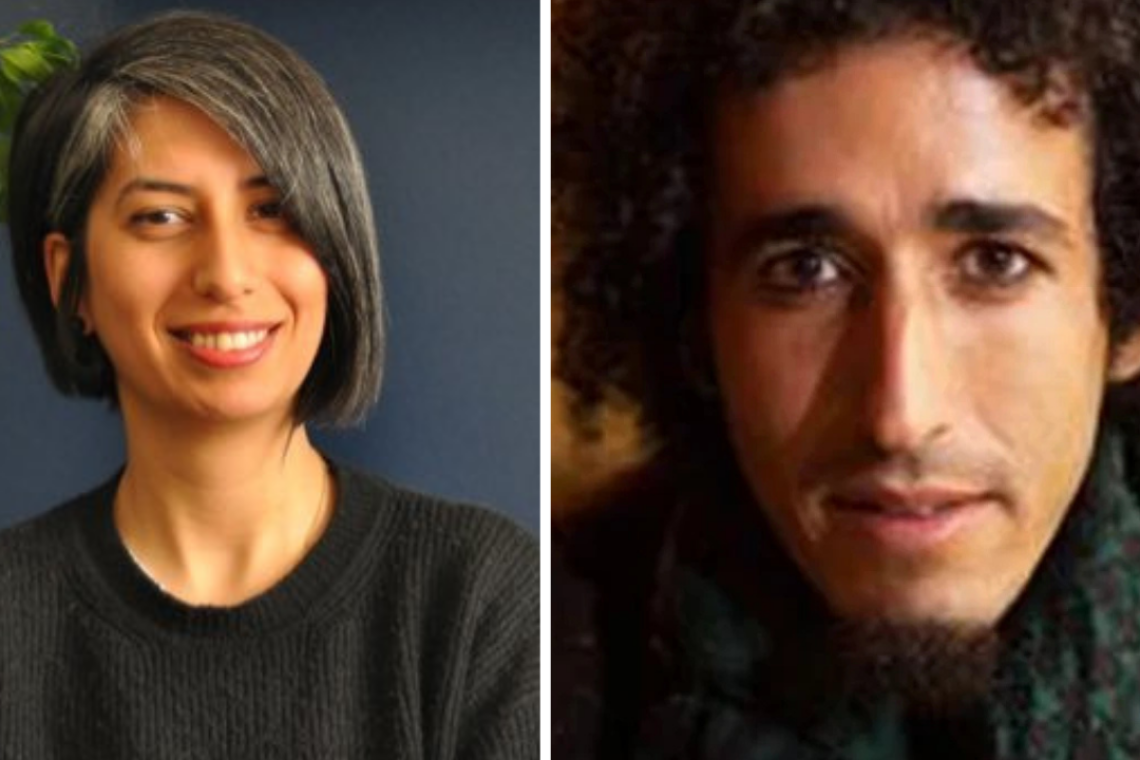
Journalist Canan Coşkun and documentary filmmaker Kazım Kızıl are standing trial alongside Şaban Vatan, the father of Rabia Naz Vatan, over an interview they conducted with Mürsel Küçükal, a witness who changed his testimony five times in the investigation into Rabia Naz’s suspicious death. At the first hearing, Küçükal said he could not remember the answers to some questions.
The first hearing in the trial of journalist Canan Coşkun, documentary filmmaker Kazım Kızıl and Şaban Vatan, the father of 11-year-old Rabia Naz Vatan, who died under suspicious circumstances in 2018 in the Eynesil district of Giresun province on Turkey’s Black Sea coast, was held Oct. 22 at the Görele 1st Criminal Court of First Instance.
Şaban Vatan attended the hearing in person at the courthouse in Görele, a district of Giresun province, accompanied by his lawyer, Sevda Karataş Şahin.
Kızıl participated in the hearing via Turkey’s Audio and Video Information System (SEGBİS) from the İzmir 63rd Criminal Court of First Instance, alongside his lawyer, Mevlüde Sena Yazıbağlı. Coşkun also attended remotely through SEGBİS from the Istanbul 52nd Criminal Court of First Instance, accompanied by his lawyer, Abbas Yalçın.
Coşkun: “I am on trial for investigating Rabia Naz’s death”
Journalist Canan Coşkun said she was being prosecuted for investigating Rabia Naz’s death. She noted that the crime scene had not been secured and that the investigation was closed in 2020 without charges being filed, drawing attention to witness Mürsel Küçükal’s repeatedly changing statements.
Coşkun said she traveled to Eynesil in 2019 to interview witnesses and shared her findings with Jale Nur Süllü, a member of the Turkish Parliament’s investigative commission. She said Küçükal voluntarily went to the scene and began crawling on the ground after Şaban Vatan arrived.
Coşkun said she could be heard telling Küçükal, “No, don’t crawl,” in an audio recording of the encounter. She added that she had not published the recordings but had kept them for a documentary project. Coşkun asked the court to acquit her.
Kızıl: “We are journalists. We would never do such a thing”
Documentary filmmaker Kazım Kızıl said they had interviewed witnesses as part of their investigation into Rabia Naz’s death and their work on a documentary. Kızıl said Küçükal began crawling on the ground to demonstrate his own account of events and that no one had directed him to do so.
Kızıl’s lawyer, Mevlüde Sena Yazıbağlı, highlighted shortcomings in the investigation and requested a new expert report and her client’s acquittal.
Şaban Vatan: “I am a father whose 11-year-old daughter was murdered”
Şaban Vatan denied pressuring or directing Küçükal. Noting that the witness had repeatedly changed his testimony, Vatan asked, “Isn’t changing your testimony and misleading the judiciary a crime?”
Vatan said he had watched footage of his daughter’s autopsy and recalled telling Küçükal, “Mürsel, I watch videos of my daughter’s autopsy. Which one of us is in shock, you or me?”
He said he had never instructed Küçükal to crawl on the ground, insisting that the witness had done so voluntarily and that he had merely recorded what happened. Vatan highlighted shortcomings in the investigation and called for the circumstances surrounding his daughter’s death to be fully investigated.
Complainant says he cannot recall his statement to police
Complainant Mürsel Küçükal told the court that he stood by the statement he had given to police and had nothing further to add. However, when questioned by the judge, he said he could not remember certain details.
When Küçükal was unable to recall parts of his account, the judge read aloud his earlier statement to police and had it entered into the hearing record. Asked whether Coşkun and Kızıl were the people who had held his arm during the incident, Küçükal said he could not remember.
Coşkun’s lawyer, Abbas Yalçın, highlighted contradictions in the complainant’s account. Coşkun also pointed out that Küçükal was changing his testimony even during the hearing, saying, “He is changing his testimony from one second to the next, even now.”
Yalçın requested that Küçükal be referred to the Forensic Medicine Institute for a psychiatric evaluation and that the video recordings be sent back to an expert for further examination.
The court adjourned the hearing until Jan. 28, 2027, at 2 p.m.
Rabia Naz’s suspicious death
Rabia Naz Vatan, 11, was found injured outside her home in the Eynesil district of Giresun province on Turkey’s Black Sea coast on April 12, 2018. She was taken to a hospital, where she died. Prosecutors closed the investigation without filing charges, concluding that Rabia Naz had died after falling from the roof of her home.
Journalists investigating Rabia Naz’s death highlighted shortcomings in the investigation and inconsistencies in witness Mürsel Küçükal’s changing statements. In a 2025 ruling on an application filed by the family, Turkey’s Constitutional Court found rights violations related to deficiencies in the way the investigation had been conducted.
Interview with witness leads to prosecution
Mürsel Küçükal was a witness in the investigation into Rabia Naz’s death, having said he saw her lying injured. He later also testified before a parliamentary investigative commission established by Turkey’s Grand National Assembly.
On Nov. 11, 2019, journalist Canan Coşkun sought to interview Küçükal while visiting Eynesil to investigate Rabia Naz’s death. According to Coşkun, Küçükal took her to the scene and began recounting what he had witnessed. Şaban Vatan and Kazım Kızıl, who were returning from Rabia Naz’s grave, joined them during the encounter.
Küçükal subsequently filed a complaint, alleging that Vatan had forced him to crawl on the ground to reenact the incident and subjected him to mistreatment. The indictment also alleged that Vatan, Coşkun and Kızıl had asked Küçükal to reenact Rabia Naz’s condition at the time of the incident.
However, the investigation file also included audio recordings indicating that Coşkun had not asked Küçükal to crawl on the ground and had attempted to stop him from doing so.
In an earlier statement, Coşkun said footage and recordings obtained during their journalistic work had been confiscated and subsequently used against them.
“If our journalistic activities in Eynesil had not been obstructed, the findings that the Constitutional Court reached seven years after the incident would have come to light much earlier,” Coşkun said.