

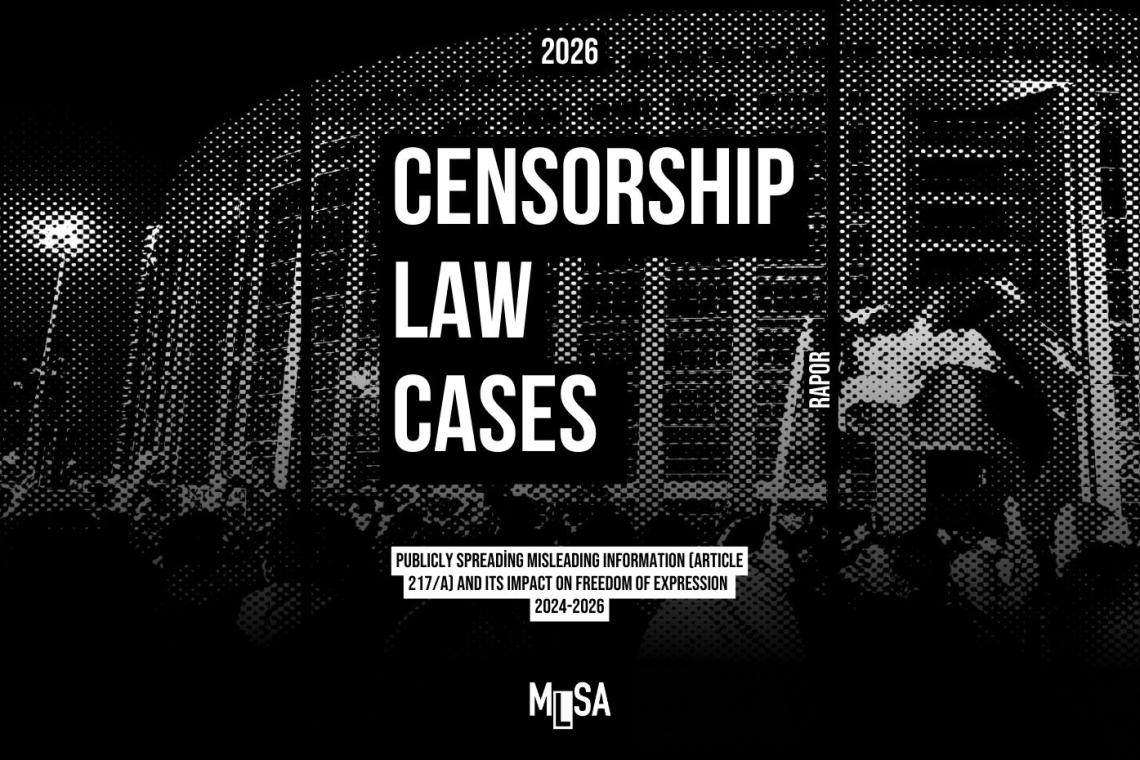
A new report by the Media and Law Studies Association (MLSA) shows that the majority of cases filed under Article 217/A of the Turkish Penal Code — widely known to the public as the “censorship law” — target journalists. According to the report, lengthy trial processes and the risk of detention, rather than convictions themselves, are creating a deterrent effect on freedom of expression.
The Media and Law Studies Association (MLSA) has published a new report examining the implementation of Article 217/A of the Turkish Penal Code, commonly referred to as the “censorship law.” Titled “The offense of publicly disseminating misleading information and its impact on freedom of expression,” the report analyzes how the law has been applied in practice based on cases monitored by MLSA between 2024 and 2026.
Within the scope of MLSA’s trial monitoring program, 39 hearings and more than 21 cases were followed, providing a significant overview of the implementation of Article 217/A. In the monitored cases, the vast majority of defendants were journalists and media workers; in more than 72% of the cases, journalists, reporters or other media employees appeared as defendants.
You can find the report here.
No convictions for journalists, but the process is deterrent
According to MLSA’s findings, none of the concluded cases in which journalists were defendants resulted in a finalized prison sentence. Nevertheless, long trial processes, the risk of detention and arrest, and high legal costs create a serious deterrent effect on journalists.
In the report, MLSA emphasizes that punishment under Article 217/A is not limited to convictions. In many cases, the trial process itself functions as a mechanism of punishment. Even when journalists are acquitted, months-long court proceedings, professional uncertainty and the risk of stigmatization can create lasting pressure on freedom of expression.
Suspended sentences prominent among non-journalist defendants
The cases monitored by MLSA also reveal a clear difference in outcomes between journalists and non-journalist defendants. While cases involving journalists mostly end in acquittals or are still ongoing, a significant portion of convictions against activists, social media users and some professionals resulted in the suspension of the announcement of the verdict (HAGB).
MLSA notes in the report that although this mechanism does not immediately lead to the enforcement of a sentence, it places defendants under the condition of not committing a new offense for five years. For this reason, it can function as a long-term tool of pressure and deterrence.
Cases intensify during periods of crisis
MLSA’s monitoring data show that cases filed under Article 217/A tend to increase particularly during periods of political and social crisis.
The report found that many of these cases were linked to the following issues:
- the Feb. 6, 2023 earthquakes and earthquake-related reporting
- election periods
- news reports concerning judicial investigations
Based on these findings, MLSA assesses that the law can be used as a tool of pressure against journalism on sensitive issues of public interest.
Scope of the law has expanded
The report also notes that the scope of Article 217/A has expanded over time. While early applications primarily targeted journalists, in recent years cases have also been directed at:
- representatives of the business community
- bar association administrators and lawyers
- health care workers
- social media users
International organizations issue warnings
The report also includes assessments by international organizations. The Venice Commission, an advisory body of the Council of Europe, warned that the vagueness of the concepts in the definition of the offense could have a deterrent effect on freedom of expression.
Freedom of expression organization ARTICLE 19 stated that the provision does not meet the principle of legality and that journalistic activities could face criminal sanctions.
MLSA: The law should be repealed or fundamentally amended
In the conclusion of the report, MLSA stresses that Article 217/A of the Turkish Penal Code, in its current form, creates serious pressure on freedom of expression.
According to MLSA, the provision should either be completely repealed or fundamentally amended in line with international standards on freedom of expression.
The report indicates that judicial practices related to freedom of expression have not changed direction; on the contrary, they appear to be becoming more systematic. The increase in acquittal rates does not mean that judicial pressure has decreased. High prison sentences, widespread detention practices, decisions on the suspension of the announcement of the verdict (HAGB), and charges whose scope is gradually expanding demonstrate that judicial intervention in freedom of expression continues through different tools.
This situation shows that punishment occurs not only through convictions but also through long and costly trial processes.