

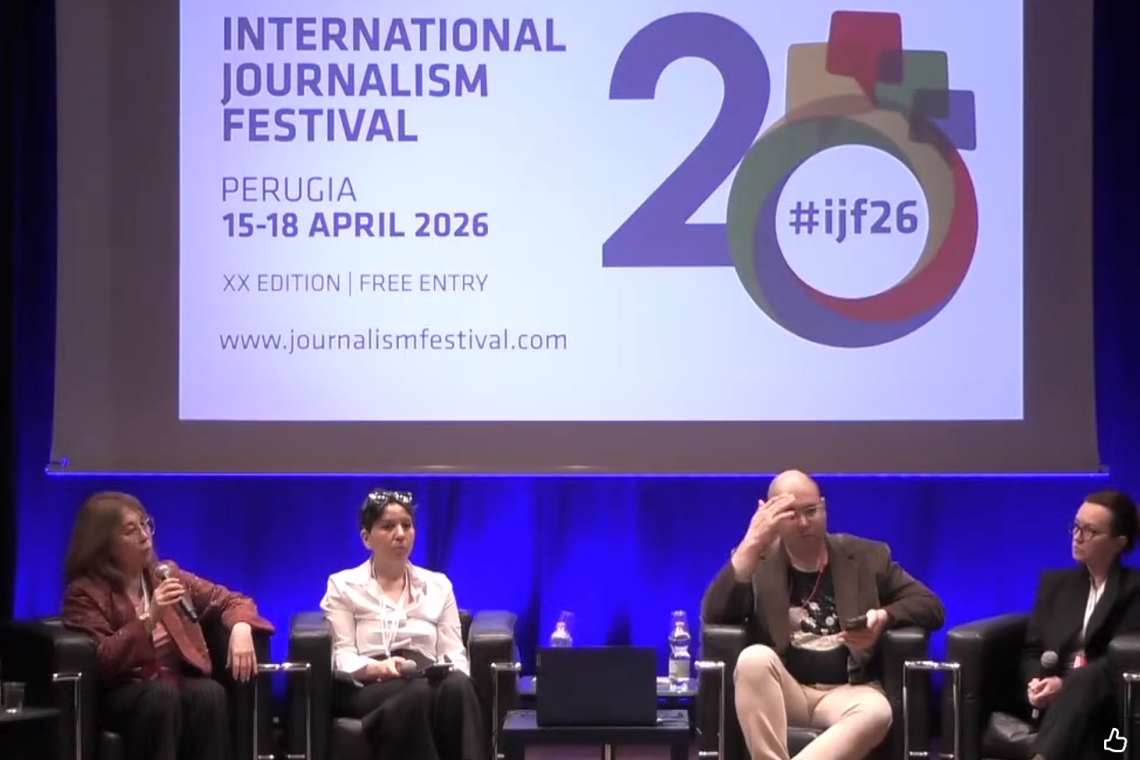
MLSA's Barış Altıntaş joins international panel at Investigative Journalism Festival in Perugia
At a panel organized by the Committee to Protect Journalists (CPJ) at this year's International Journalism Festival in Perugia, Italy, journalists and press freedom advocates from Turkey, Russia, and Kyrgyzstan examined how governments are weaponizing national security laws to silence independent reporting.
Click to watch the panel on YouTube
The session, moderated by CPJ Europe and Central Asia Program Coordinator Gulnoza Said, brought together MLSA Co-Director Barış Altıntaş, Radio Free Europe/Radio Liberty journalist Alsu Kurmasheva — who spent several months in Russian detention before being released in the August 2024 prisoner exchange — and Rinat Tuhvatshin, co-founder of the Kyrgyz investigative outlet Kloop, which has been designated "extremist" by Kyrgyz authorities and now operates entirely in exile.
Turkey: the judiciary as a tool of repression
Altıntaş presented data from MLSA's ongoing trial monitoring program, which has tracked journalist trials since 2018. Of the approximately 300 journalists whose cases MLSA monitors annually — across hundreds of hearings — 72% face terror-related charges under Turkey's 1991 Anti-Terror Law. She emphasized that acquittals are frequent, exceeding 65% of cases, but that the use of pre-trial detention means journalists often serve months behind bars before charges are even dropped. "Turkey uses jail time as the punishment," she said.
Altıntaş offered several illustrative examples: 18 Kurdish journalists rounded up in Diyarbakır in 2022, held for 13 months before their first hearing, then acquitted; a journalist imprisoned for 100 days in a single-cell isolation for posting a screenshot of a publicly available official gazette document; and, just days before the panel, journalists detained in connection with an IFJ press card payment recorded in an indictment as "financing terrorism." She also flagged the growing use of a 2022 disinformation law as an additional instrument against journalists, noting its increasingly indiscriminate application.
On what can be done, Altıntaş pointed to robust legal support enabling acquitted journalists to pursue cases at the European Court of Human Rights, systematic documentation and archiving of censored content, and the importance of foreign trial monitors — particularly in smaller cities outside Istanbul. "It definitely helps in how the journalist is treated. They feel they are not alone," she said.
Russia and Kyrgyzstan: escalation and exile
Kurmasheva, speaking from her own experience of imprisonment, described how Russia has expanded beyond foreign agent laws into direct treason charges carrying potential lifetime sentences. She urged continued solidarity with imprisoned journalists — including through something as simple as sending postcards — and called for democratic governments to condition trade and diplomatic relations on the release of jailed journalists, backed by concrete legislation rather than hashtags.
Tuhvatshin described the methodical campaign against Kloop: website blocking, dissolution of its legal entity, imprisonment of staff on fabricated extremism charges, and ultimately an Interpol red notice and diffusion request. He argued that repressive governments don't need foreign agent laws specifically — they will exploit whatever legal quirks are available. Operating fully in exile, he said, had paradoxically freed Kloop from the self-censorship that had shaped its reporting while colleagues remained inside the country.
The panel concluded with audience questions touching on Hong Kong and the United States, where panelists drew parallels with the encroachment on press freedom in countries that have historically served as reference points for democratic standards. "Democracy is very fragile," Altıntaş said. "Most people don't realize that yet."
MLSA has monitored journalist trials in Turkey since 2018 and provides legal support to journalists facing prosecution. For more on MLSA's trial monitoring data, visit mlsaturkey.com.