

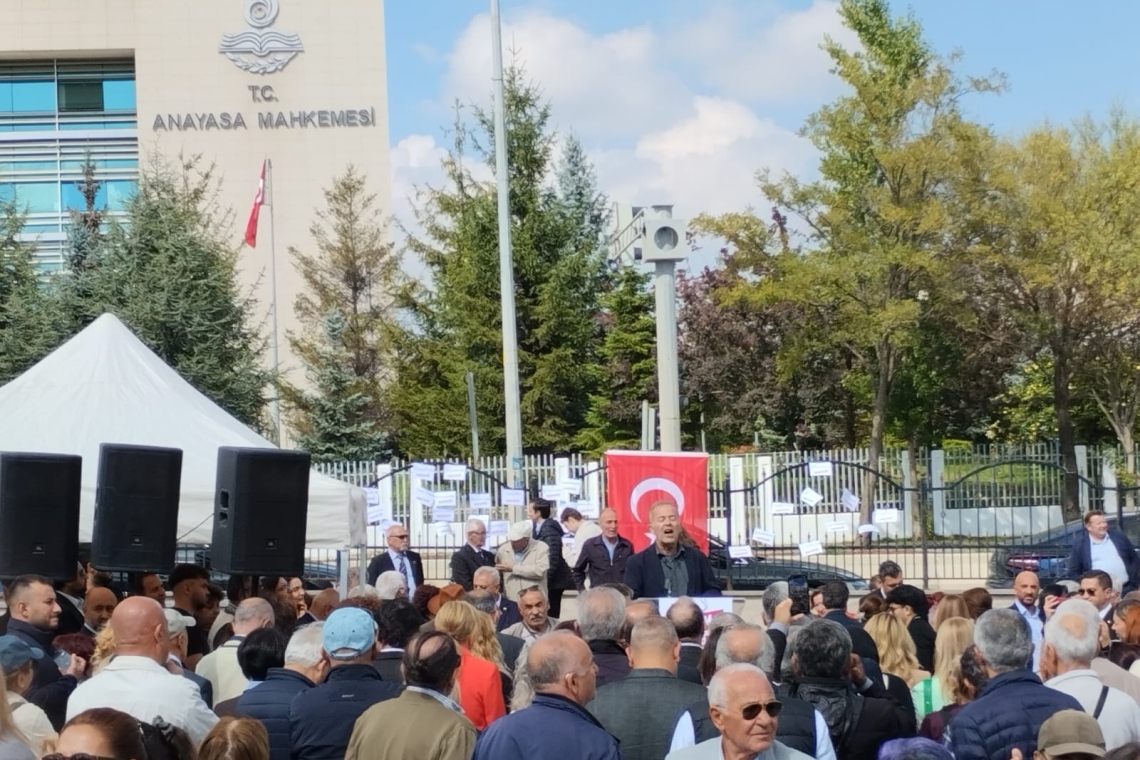
Press organizations, civil society groups and political party representatives gathered outside Turkey’s Constitutional Court at the call of the YENİ Party to protest restrictions on access to social media accounts and call for the protection of freedom of expression and press freedom.
Büşra Genel
YENİ Party called for a protest outside Turkey’s Constitutional Court in Ankara against a growing number of orders blocking access to the social media accounts of journalists and civil society organizations, including the Media and Law Studies Association (MLSA).
Representatives of press organizations, civil society groups and political parties gathered outside the court, where speakers addressed what they described as increasing censorship and restrictions.
The names of journalists and civil society organizations whose accounts had been blocked were written on sheets of paper and displayed outside the Constitutional Court.
Representatives of the Freedom of Expression Association, the Journalists’ Union of Turkey (TGS), DİSK Basın-İş, the Dicle Fırat Journalists Association, the EŞİK Platform, the Confederation of Public Employees Trade Unions (KESK), LGBTQ+ rights group KAOS GL and the All Pensioners’ Union spoke at the protest, alongside representatives of the DEVA Party, the Felicity Party and the pro-Kurdish DEM Party.
Journalist Özlem Akarsu Çelik spoke on behalf of journalists whose social media accounts had been blocked. KAOS GL Editor-in-Chief Yıldız Tar and Freedom of Expression Association representative Kerem Altıparmak were also among the speakers.
Utku Çakırözer, YENİ Party deputy chair responsible for media affairs, said in his opening remarks that the gathering aimed to make the voices of people affected by what he called growing censorship and pressure heard.
“We are faced with a disgraceful picture outside the Constitutional Court, one in which the voices of journalists and all civil society organizations are being silenced,” Çakırözer said. “We have gathered here today to make those silenced voices heard.”
Speaking after Çakırözer, YENİ Party Deputy Chair Gökhan Günaydın said the Constitutional Court had not issued a stay of execution against the censorship law for 14 years, arguing that it had therefore lost the ability to preserve its own institutional relevance.
Addressing the Constitutional Court directly, Günaydın said: “Take up this issue as a priority, issue a stay of execution and strike it down without delay. If there is no freedom of the press or freedom of expression, nothing else remains. You cannot silence Turkey through censorship.”
Günaydın said journalists and representatives of civil society organizations whose social media accounts had been blocked would be given the floor first. “We have gathered here to make the voices of those who have been silenced heard,” he said.
Kerem Altıparmak, speaking on behalf of the Freedom of Expression Association, which is among the organizations whose social media accounts have been blocked, said the group had filed more than 1,000 applications with the Constitutional Court over years of efforts to challenge the growing number of social media restrictions in Turkey.
Altıparmak said the Constitutional Court could no longer be regarded as an effective judicial body. He said there was little meaning in restoring access to blocked accounts five years later and argued that what he called the “scourge” of the Criminal Judgeships of Peace should be abolished in this context.
Speaking after Altıparmak, journalist Özlem Akarsu Çelik, a board member of the Turkish Journalists’ Association, said: “We are here because steps are being taken to prevent us from reaching the public simply because we do work in the public interest.”
Akarsu Çelik said her own account was among those targeted by access-blocking orders, adding that she was no longer able to access a news report she had published years earlier about an alleged fund fraud because it had also been blocked.
She said journalism necessarily meant taking the side of human rights. “A journalist cannot be neutral when it comes to human rights and fundamental freedoms; journalists have to stand on their side,” Akarsu Çelik said. “We stand by what we have said.”
Sinan Tartanoğlu, head of the Ankara branch of the Journalists’ Union of Turkey (TGS), said: “The fact that such a disgraceful scene has been set up outside the Constitutional Court in a country governed by the rule of law is something we should all reflect on.”
Tartanoğlu continued:
“Just last week, a person died by suicide outside the Constitutional Court while seeking justice. If journalists had not reported that person’s suicide, no one would have known about it at the time. The aim of blocking journalists’ accounts is to conceal information and undermine the public’s ability to question what is happening.
“Journalists are constantly being prevented from doing their jobs. As professional organizations, we repeatedly gather outside the Justice Ministry. Tomorrow at noon, we will again gather outside the ministry for journalist Derya Okatan. We say once again: Journalism is not a crime. We do this work both for ourselves and for society.”
Speaking after Tartanoğlu, KAOS GL Editor-in-Chief Yıldız Tar said he headed an online news outlet whose website had been blocked three times and whose social media accounts had been restricted countless times.
“We were blocked on the grounds that we were spreading ‘LGBT propaganda,’” Tar said. “We are not trying to make anyone LGBT+. That is not possible anyway. We are fighting to live as we are, with lives worthy of human dignity.”
Referring to an operation targeting the KAOS GL Association, Tar unfurled an LGBT+ flag and continued:
“We have not only been blocked. Members of our association’s executive and supervisory boards are currently being held in very poor conditions at Sincan Prison,” he said, referring to the prison complex in Ankara. “And the reason is the colors on this flag. These colors have become the colors the political authorities fear most, because they are trying to make us scapegoats to cover up their own funding schemes, workplace deaths, child labor in MESEM vocational training centers and all their other failures.
“But let us make this absolutely clear: We are nobody’s scapegoat. We want to live with dignity. We do not want to be persecuted. And I am calling on everyone from here: If we do not defend LGBT+ rights today, what is happening to us will happen to the whole of society tomorrow.
“They see us as weak and alone, but I know that we are not alone. We were blocked for reporting on the killing of a transgender person. We were blocked for reporting on our friend who was killed by a police officer. We will continue our struggle for dignity. Come and join us.”