

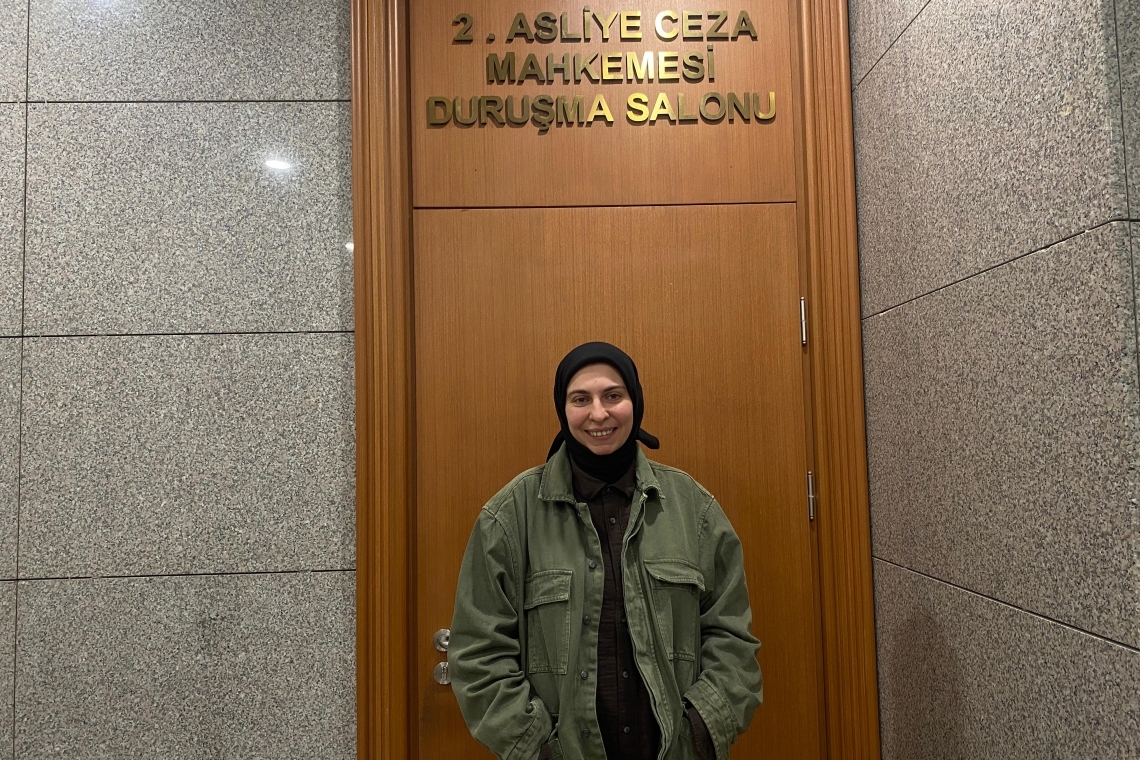
- The prosecutor presented the final opinion on the merits about Feyza Nur Çalıkoğlu after a recess and while the defendant was not in the courtroom; demanded punishment.
- The court granted additional time to the defense but did not issue a ruling regarding the request to hear the lawyers mentioned in the news story as witnesses; the hearing was postponed to February 26.
Rabia Çetin
Journalist Feyza Nur Çalıkoğlu appeared before a judge for the second time in the case in which she is on trial for reporting on allegations of ill-treatment at the Çatalca Removal Center.
At the hearing, the prosecutor presented his final opinion on the merits while the defendant was not in the courtroom and demanded punishment.
The second hearing of the case in which journalist Feyza Nur Çalıkoğlu is being tried on the charge of “publicly disseminating misleading information” due to her reporting on allegations of ill-treatment at the Çatalca Removal Center was held at Istanbul 2nd Criminal Court of First Instance.
At the hearing, which started on time, Feyza Nur Çalıkoğlu and her lawyer were present. Representatives from the Istanbul Bar Association Human Rights Center, Mazlumder, the Migrant Refugee Solidarity Network, and RSF Turkey Representative Erol Önderoğlu attended the hearing.
After identity verification and the judge stating the charges against her, Feyza Nur Çalıkoğlu gave her defense and said the following:
“As a journalist, according to constitutional jurisprudence, I do not have an obligation to act like a prosecutor and present my news reports with documents. I wrote it as an allegation. I am interested in Removal Centers, I consult expert lawyers in this field. Migrants who leave there do not easily answer a question. This is also proof of the fear and pressure there.”
“As a journalist, I exercised my right to freedom of expression”
“I did not lead the public to fear and panic. The news was already read very little,” said Çalıkoğlu, and continued as follows: “But what makes me happy is that as I report on this issue, ministries and authorities issue statements regarding the human rights violations there. A pregnant migrant remained in the removal center despite being at risk of miscarriage and lost her baby, a migrant committed suicide in a removal center. These are proof of what is happening there. As a journalist, I exercised my right to freedom of expression and to inform the public.”
Then her lawyer Serpil Özcan gave a defense and said: “It is clearly evident that my client acted with the function of informing the public as a journalist. We request her acquittal.”
Prosecutor presented final opinion on the merits while the defendant was not in the courtroom
When asked for the final opinion on the merits, the prosecutor requested a recess. A 5-minute break was given to the hearing. After the break, the judge stated that the prosecutor had presented the final opinion on the merits and demanded that Çalıkoğlu be punished for the alleged crime. The prosecutor did not present the final opinion on the merits while the defendant was in the courtroom.
In response to the final opinion on the merits, Çalıkoğlu requested that the lawyers mentioned in the news story be heard as witnesses.
Çalıkoğlu’s lawyer also requested additional time to prepare a defense against the final opinion on the merits.
The judge accepted the request for time but did not issue any ruling regarding the request to hear the lawyers mentioned in the news story as witnesses.
The hearing was postponed to February 26 at 12:00 p.m.
What had happened?
Karar newspaper reporter Feyza Nur Çalıkoğlu was put on trial on the charge of “publicly disseminating misleading information” due to her news story titled “Striking allegations from lawyers about the Removal Center: ‘Silent Room’ and ‘Cold Room’ torture” published on karar.com on November 7, 2024.
Journalist Çalıkoğlu, who brought the allegations of ill-treatment in removal centers to the agenda by collecting opinions from lawyers, first appeared before the judge at the Istanbul 2nd Criminal Court of First Instance on September 18, following a complaint by the Directorate General of Migration Management under the Ministry of Interior.