

Meltem Akyol
“On Thursday we are sending cards to imprisoned women journalists in Diyarbakır, Van and Istanbul. March 8 became our excuse this time; we are raising the struggle for women’s freedom in every field. Let’s spread it hand to hand, and those who are in Istanbul should meet in front of the Beyoğlu PTT.”
Pınar Gayıp shared this message on her social media account on March 4, 2025. She says: let’s send cards to women journalists inside prison. Pınar is only one of the women journalists who are in prison for March 8. I guess this is what it means to be a woman journalist in Turkey.
Harassment, threats, mobbing, mansplaining, unemployment…
Today, writing a list of problems related to journalism and what journalists experience in Turkey would take a long time. Even the summary of 2025 alone is quite long. For example, according to Reporters Without Borders’ (RSF) 2025 Press Freedom Index, Turkey fell to 159th place among 180 countries.
In the Council of Europe’s Platform for the Safety of Journalists’ 2025 Europe Press Freedom Report, Turkey is described as “one of the most challenging environments in Europe for independent journalism,” and the country is said to be characterized by legal harassment, intimidation and censorship. According to the report, “Belarus, Georgia, Serbia, Russia and Turkey, along with the regions of Ukraine under Russian occupation, were the places where the most threats to press freedom were recorded.”
Again according to the report, Turkey is among the top three countries for physical attacks against journalists during protests.
Yes, being a journalist in Turkey is difficult, but being a woman journalist is even more difficult. On one side there is detention, arrest, judicial harassment; on the other side violence, pressure, sexism, harassment, mobbing, inequality, mansplaining… Alongside all this there is also the masculine and sexist language of the media. Moreover, digital versions of these forms of violence are increasingly being experienced today.
A report by the Council of Europe’s Platform for the Safety of Journalists shows that 87 percent of women journalists are subjected to online violence and abuse because of the news they produce. According to a new analysis published by RSF, which states that developments in artificial intelligence technology have led to a “global wave of disinformation and harassment” targeting journalists, 74 percent of the “deepfake” attacks detected worldwide in the last two years targeted women journalists.
Let’s make it concrete… Journalist Özlem Gürses was targeted after a news segment she presented was cut and circulated out of context. Gürses stated that she received death and rape threats and requested protection:
“My phone number is being shared. On Telegram I deal with men calling me — people with WhatsApp profile photos that look like ISIS militants — saying they will rape my 80-year-old mother,” she said.
Even worse, Gürses is not alone. Almost every day a woman journalist, or sometimes more than one, is targeted, threatened and subjected to online lynching. Some of them are arrested.
Imprisoned women journalists: We will not be on the streets this March 8, but…
According to the 2025 Press Freedom Report prepared by CHP Member of Parliament Utku Çakırözer, who has a background in journalism, journalists appeared before judges 610 times in the past year. According to data from the Journalists’ Union of Turkey (TGS), there are 15 journalists and media workers currently in prison in Turkey. Four of them are women. According to the Media and Law Studies Association (MLSA), the number of imprisoned journalists is 28, six of whom are women.
Three women journalists recently added to this list — Pınar Gayıp, Nadiye Gürbüz and Elif Bayburt — were arrested on Feb. 3, 2026 after a raid on the Aksaray office of the Etkin News Agency (ETHA). The journalists who called for solidarity with imprisoned journalists on March 8 last year are now themselves in prison.
The accusations include many things that could be considered part of journalists’ daily professional routine: following the courthouse agenda, covering funerals and commemorations, recording footage, maintaining contact with the newsroom and small money transfers.
Pınar Gayıp, Elif Bayburt and Nadiye Gürbüz, who shared solidarity messages for imprisoned women journalists last year, will spend this March 8 not covering news on the streets but in prison. The message they sent to MLSA is common: if journalism is seen as a crime by the government, we will continue to commit this crime. We will continue doing journalism.
Another message Pınar Gayıp sent to the newspaper Yeni Yaşam concerns March 8:
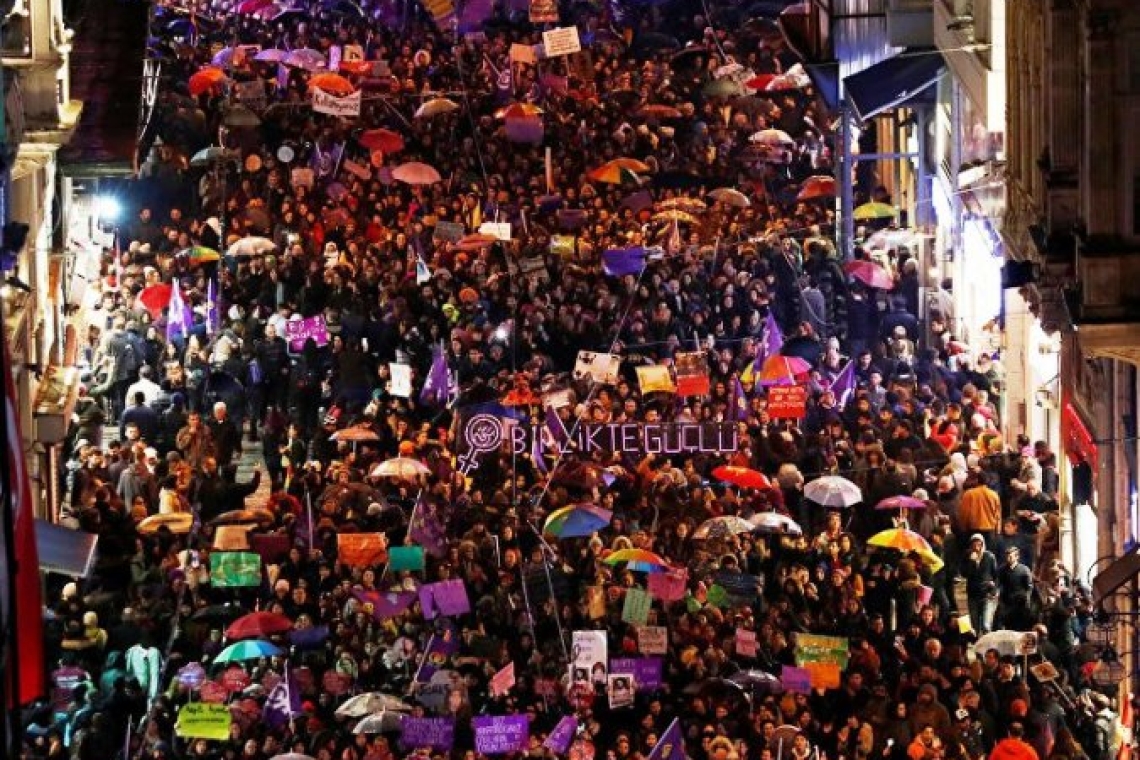
“The unity of heart between the women who will take to the streets on March 8 and the women walking in this 25-step courtyard, and the courage of the women resisting here and the women who never leave the squares despite attacks, are the same. This year we will not be on the streets on March 8, but our slogans will unite with the slogans rising in squares from city to city. Women resisting everywhere will meet.”
Women outside
While reporting you may face violence from the police; while conducting an interview you may face violence from a man. While following news in the field you may be crushed or subjected to violence by a male colleague. Someone you reported on may call you and use sexist insults if they do not like the story. A male news source you call during daytime working hours may call you back late at night. When applying for a job you may be questioned about whether you are married and whether you plan to have children. While working you may not receive the same salary as men doing the same job. Being promoted is difficult; becoming unemployed is easy.
Journalist Eylem Nazlıer has completed 10 years in the profession. She says she has experienced almost every form of violence mentioned above:
“Last March 8 our colleagues Pınar Gayıp, Hatice Duman, Elif Bayburt and Nadiye Gürbüz were covering events in the field. Today they are detained and in prison. Those of us who remain outside encounter police violence in the field. We are threatened with detention. The news we produce becomes the subject of investigations. We are lynched on social media. We are exposed to curses and insults. And because we are women these attacks become even more reckless. We are targeted for the color of our hair, our weight, our physical appearance. Over the past two days women journalists have been openly targeted on social media. Instead of debating, our work is belittled by saying ‘someone’s wife,’ and the work we do is devalued. We are already fighting a battle in the field itself. On top of that we face violence from our male colleagues. Yes, you heard that right: from our male colleagues. Alongside all this there is also a harsh economic reality. It is almost impossible to make a living with the wages we receive. For this reason the number of women colleagues leaving the profession is increasing. In fact, what we experience as women journalists is not very different from what other women in this country experience. With the economic crisis we too are becoming poorer. We too are trying to live by cutting down our lives.”
A struggle with male journalists in the field as well
While women journalists look for ways to protect themselves from police violence in the field, they also struggle with male colleagues. Journalist Evrim Kepenek says that before every March 8 women journalists talk about how to protect themselves from police violence while covering events:
“While working in the field we face violence most often from the police, and it is not only physical violence. There are also insults, shouting and abusive language. And not only that. We also have to deal with male colleagues in the field who say ‘I will take the best photo or footage.’ In other words we constantly have to explain that women are journalists and that they practice journalism just like men.”
‘Part-time waitress, full-time journalist’
According to data from professional organizations, the unemployment rate among journalists exceeds 20 percent. Even though there is no specific emphasis on women in this figure, it is not difficult to assume that the number is higher among women.
A woman journalist — I will call her Leman — is one of the unemployed journalists.
“In a male-dominated media it is already very difficult to hold on as a woman. Especially when you know you will be the first person to be discarded at the slightest problem…” she begins.
“For the most exciting, the biggest, the worst or the best news stories, men were preferred, not women. And when looking for a job, women are not the first choice either,” she says, explaining that discrimination is not limited only to the workplace.
As unemployment drags on, while trying to find ways to practice her profession she also works part-time as a waitress to survive economically:
“In this way I both do the job I love so much for a few pennies and try to make a living at the same time. I know I am not alone. I know that the discrimination leaking through that glass ceiling hits us first in offices and in the field.”
‘We will not give up’
Yes, the picture is not very bright. And it does not seem likely to change in a short time. But despite everything, women journalists remain determined to practice their profession. Their words converge:
“Journalism is not a crime. Despite all the difficulties, women journalists are not giving up our profession. And imprisoned women journalists must be released.”