

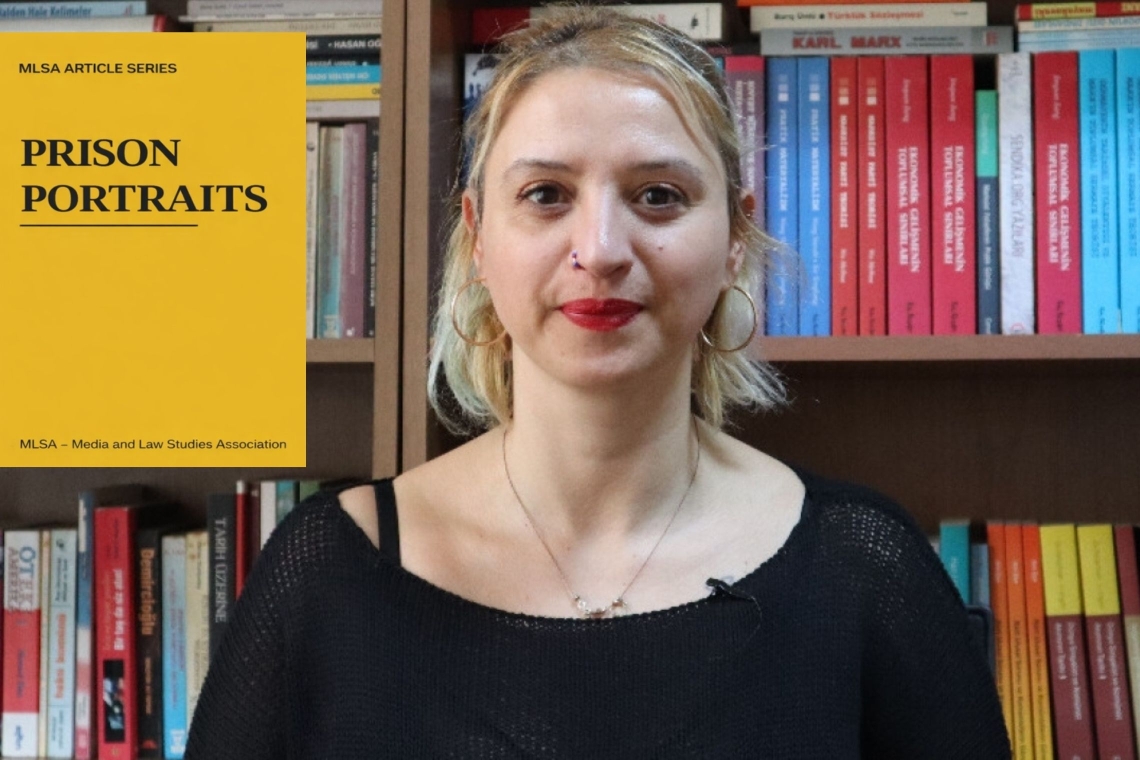
- In the first of the Prison Portraits article series, ETHA editor Pınar Gayıp, whose legal defense is undertaken by MLSA, tells about her experience from the moment of detention to life in the ward through answers she sent from prison.
- Gayıp states that journalistic activities are made the subject of accusations in the investigation file and says, “The crime attributed is my journalism.”
- Describing what she experienced during the detention process, Gayıp recounts that a female police officer wanted to watch her in the toilet, adding that the officer’s words, “I need to watch you while you use the toilet and while you get dressed,” became engraved in her mind.
MLSA – Prison Portraits
In recent years in Turkey, cases concerning freedom of expression and the press have been leaving their mark not only in courtrooms but also in prison wards. Journalists, politicians, academics and activists are sometimes deprived of their freedom because of a news story, sometimes a speech, and sometimes a social media post. While the agenda outside flows rapidly, time inside follows another rhythm.
In this series, the Media and Law Studies Association (MLSA) sends the same set of questions to people who are in prison and records what they tell from inside. Extending from the moment of detention to the first night, and from daily routines in prison to the connections established with the outside world, these questions aim to make visible the small but decisive moments of life inside.
Every letter begins with the same questions but does not tell the same story. Some questions remain unanswered, while a few sentences are enough for others. Still, the texts that emerge reveal the experience behind prison walls in all its aspects: waiting, routine, solidarity and the time shaped inside.
“Prison Portraits” publishes these testimonies as they are. The answers are conveyed without being changed, shortened or supplemented with commentary. Because the most direct way of telling a story is to leave the word to its owner.
Pınar Gayıp tells
Journalist Pınar Gayıp, who was arrested as part of the operation against the ETHA News Agency, says that the investigation conducted against her focuses on journalistic activities. In the file, many headings that could be considered part of a journalist’s daily professional routine — following the courthouse agenda, attending funerals and commemorations, taking footage, keeping contact with the newsroom and small money transfers — become the subject of interrogation questions.
Gayıp, whose defense is undertaken by MLSA, rejected the accusations by emphasizing in her statement before the judge that all these activities are a natural part of journalism. Saying that the claims directed at her consist only of journalistic activities, Gayıp also evaluates her detention as a “political process” for this reason.
Responding to the questions sent by MLSA to journalists in prison, Gayıp tells what she experienced on many topics, from the moment of detention to the daily routine in prison and how time flows inside, as well as her perspective on journalism.
Moment of detention: “They wanted to watch me in the toilet”
What did you feel at the moment you were detained? Were you expecting it?
For a long time I had been under judicial threat because of my news reports. Therefore I was prepared for a detention and arrest attack.
When your door was knocked on / your house was raided / you were summoned, what were you thinking?
When our door was knocked on, I immediately headed to the door to open it. Because the aim of the police is to criminalize you with the noise they create. I tried to prevent this. I tried to calm them down in order to prevent them from beating us. They asked us to lie on the ground and turn our faces to the wall. I explained that this would not be possible. Meanwhile I told them they should not make too much noise, that I was already at home and had opened the door for them.
What was the hardest thing for you during the detention process: uncertainty, treatment, or waiting?
I was detained many times because of my news reports and was arrested three times. Frankly, it was that I did not have such a feeling.
At that moment did you think with your identity as a journalist/politician, or simply as a human being?
With my identity as a journalist… I approached it with the responsibility that I needed to follow everything and make it known.
Was there a moment when you said, “So this will happen too”?
Yes. A female police officer insisted on coming with me to the toilet and watching me. I had never thought that I would need to resist in order to be able to go to the toilet alone.
How did you spend the first night? Were you able to sleep?
I slept because I was very tired.
During that process, did a sentence, a look or a sound remain engraved in your memory?
“I need to watch you while you use the toilet and while you get dressed.”
Arrest decision: “The only thing shown as evidence in the file is my journalism”
What did you feel when you heard the arrest decision?
From the first moment I was detained I thought that I would definitely be arrested.
Were you hopeful while waiting for the decision?
The process is political. The only thing shown as evidence in the file is that I am a journalist. A file prepared to arrest.
Do you think you committed a crime?
Absolutely not. The crime attributed is my journalism. I will definitely not take a step back from it.
A day in prison: “It is hard to believe but 24 hours is not enough”
How does your day start?
I wake up at 07:00 in the morning. After the headcount I read books and write. Every day I definitely do one hour of sports.
What do you do first in the mornings?
I do not neglect my walking, which is called “volta”.
Do you read? What do you read?
I am currently reading the Paris Düşerken series.
Do you write?
Yes. Since I was arrested I have written two articles and conducted one interview.
Do you do sports?
At least one hour every day.
How does time flow inside?
It is hard to believe but 24 hours is not enough. This is completely related to how a person conditions themselves. Life flows like outside. We draw the boundaries. The day passes quickly with reading books, writing, sports, walking and conversations with other detainees.
Connection with the outside
How does it feel to receive letters?
For detainees, a letter is a moment of limitlessness.
Ward life
How is your relationship with those staying in the ward?
I stay in a political ward. For this reason every conversation with prisoners is like a lesson.
Justice
What does justice mean to you?
Justice today is a phenomenon applied by those in power for their own interests. We are concrete examples of this today. News reports shown by informants are considered “membership in an organization.”
Messages: “We respond with solidarity to the increasing attacks on the press”
What would you like to say to those who judge you?
I already say that I am a journalist, that I am the editor of ETHA. I am also a 50 percent partner of ETHA. My name and signature appear in all official monitoring. My news reports are published with the signature of ETHA editor. I participate in all programs with this title. There was no need for informants. I am an ETHA editor.
To those who support you?
We never doubted solidarity. We respond with solidarity to the increasing attacks on the press. Thanks to everyone who sees this attack, opens ETHA in the mornings, supports us with articles and news, and mentions our name. These attacks will continue and we will again respond by standing side by side.
Do you have a message for society?
We journalists struggle for the public’s right to news, for them to access the truth. But this becomes strong when it is mutual. You must also struggle for your right to access real news. Therefore we insist on journalism, and you should struggle together with press workers who stand against lies.
How would you explain in one sentence that journalism is not a crime?
If journalism is seen as a crime by the government, I will continue to commit this crime. Our productions are the practice of our word against those who try to silence us by arresting us.