

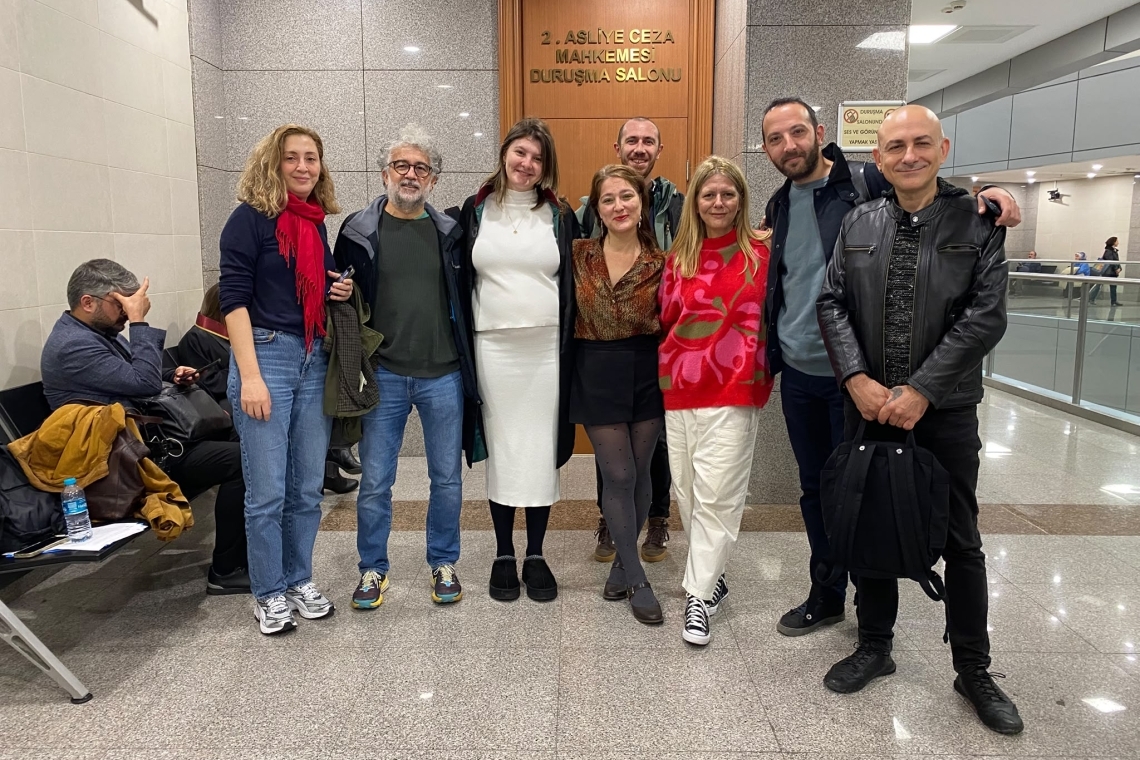
The case against journalist Tuğçe Yılmaz, who was prosecuted under Article 301 of the Turkish Penal Code over her news report titled “Armenian youth in Turkey speak out: 109 years of mourning,” has been dismissed because the charges were not filed within the four-month legal deadline stipulated by Turkey’s Press Law.
Semra Pelek
The third hearing in the case against journalist Tuğçe Yılmaz, charged with “publicly denigrating the Republic of Turkey,” was held at Istanbul’s 2nd Criminal Court of First Instance. Yılmaz and her lawyer, Deniz Yazgan, attended the hearing.
In her defense statement, Yılmaz said she was being prosecuted for reporting on a condolence message President Recep Tayyip Erdoğan sent to the Armenian Patriarchate on April 24, 2025, a date marking the annual commemoration of the mass killings of Armenians during the Ottoman Empire. In his message, Erdoğan said they would continue to honor the memory of Ottoman Armenians, emphasized the shared culture of coexistence between Turks and Armenians, and used the phrase “shared pain.”
“According to the prosecutor’s argument, this message could also be subject to an investigation. However, because the message came from President Erdoğan, such an investigation would not be possible,” Yılmaz said in her defense statement.
Yılmaz said Erdoğan would send another condolence message to the Armenian Patriarchate this year, adding, “And I will report on that message, just as I do every year.”
Yılmaz said the investigation against her was launched following a complaint submitted to the Presidential Communication Center (CİMER) by an individual whose identity and motives remain unknown. She said she had been subjected to pressure for two years since the complaint was filed. She also described the decision to prosecute her despite the expiration of the legal deadline for filing charges as a violation of her rights.
Yılmaz recounted being stopped by police officers on her way home and being forced to spend a night in police custody. She said she later learned that she had been monitored using facial recognition technology.
“Detaining a journalist over a news report cannot be considered a normal or legitimate measure,” she said.
Yılmaz, who has worked as a journalist since 2015, said she has sought to amplify the voices of people and animals subjected to discrimination and injustice or whose suffering otherwise goes unheard.
“I see journalism as a means of defending rights, including, when necessary, the rights of those of you who are putting me on trial today but who may yourselves face injustice tomorrow,” she told the court.
Yılmaz argued that her news report contained no statements that could substantiate the charge against her.
“I produced this news report because that is my job. Reporting the news is also how I earn my living,” she said.
Recalling that Erdoğan himself had described the occasion in terms of “shared pain,” Yılmaz said she hoped for reconciliation among Armenian, Turkish and Kurdish communities and was working toward that goal.
Yılmaz also invoked the case of Hrant Dink, the Turkish-Armenian journalist who was prosecuted under Article 301 before his murder in 2007. She noted that other journalists prosecuted under the same provision after Dink’s killing had been acquitted.
Pointing to ongoing efforts to normalize relations between Turkey and Armenia, Yılmaz argued that there was no legal basis for prosecuting her over her journalistic work and requested an acquittal.
Lawyer: Case filed after legal deadline expired
Yılmaz’s lawyer, Deniz Yazgan, said the case against his client was filed two years after a complaint was submitted to the Presidential Communication Center (CİMER), and that the identity of the complainant had still not been established.
Highlighting deficiencies in the case file, Yazgan cited European Court of Human Rights (ECtHR) rulings concerning Article 301 of the Turkish Penal Code and argued that the deadline for filing charges under Article 26 of Turkey’s Press Law had expired.
Yazgan also recalled the murder of Armenian journalist Hrant Dink, saying Turkey needed to confront what Dink’s widow, Rakel Dink, described after her husband's killing as “the darkness that turns a child into a murderer.”
Yazgan requested that the case be dismissed because the statutory deadline for bringing charges had expired.
The prosecutor reiterated the final opinion previously submitted to the court, calling for Yılmaz to be convicted and sentenced.
Asked for her final statement, Yılmaz said, “I want to have faith in the rule of law. I hope your decision will contribute to positive developments in the normalization process between Turkey and Armenia.”
The court ruled that the case had not been filed within the four-month statutory deadline stipulated by Turkey’s Press Law and ordered its dismissal.