

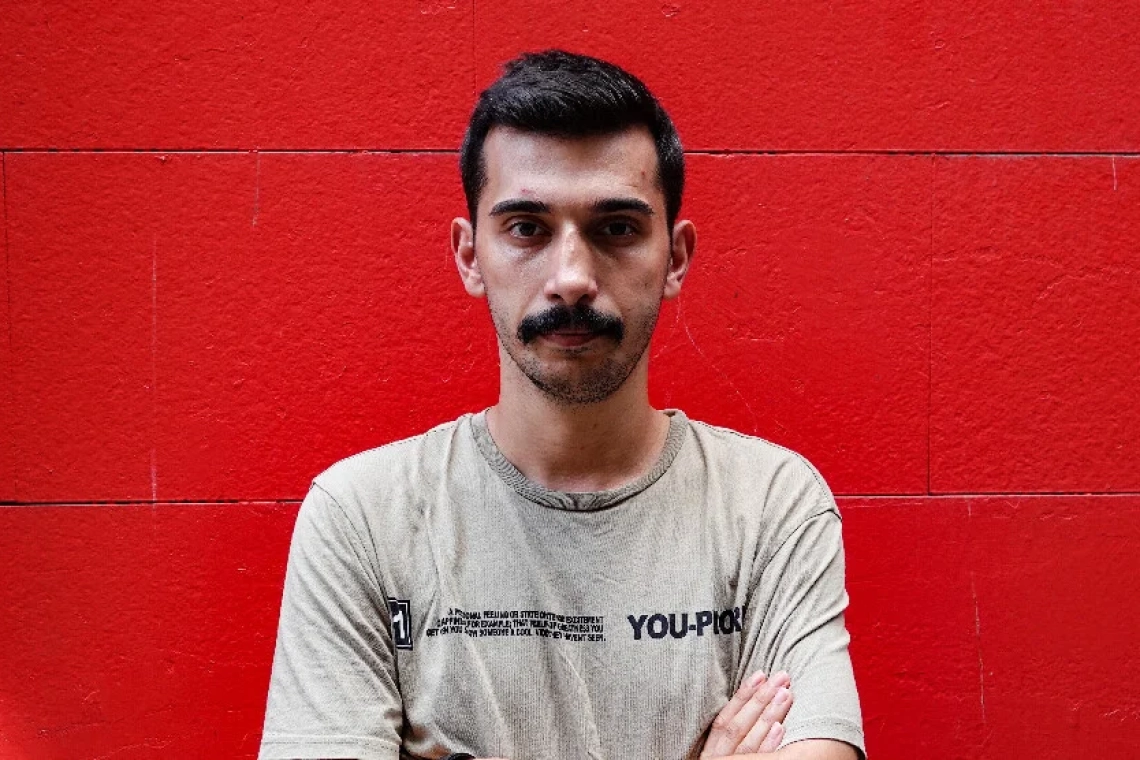
More than three months after the NATO summit in Ankara, some of those arrested on the grounds that they might engage in protest activity remain behind bars. Birsen Karakum, whose son Emir Karakum is being held at Silivri Prison near Istanbul, makes a 12-hour journey from the Black Sea city of Samsun every month to visit him for just 45 minutes.
Meltem Akyol
Months have passed since the NATO summit in Ankara. The political agenda has shifted, and the news reports have faded from the headlines. But for some, time has stood still, particularly for the families of those detained and arrested on the grounds that they might engage in protest activity.
The Karakum family is among them. Emir Karakum, a 35-year-old history teacher, has been held at Silivri Prison near Istanbul since June 26. His mother, Birsen Karakum, travels from the Black Sea city of Samsun to Istanbul every month, making a journey of approximately 12 hours for just 45 minutes with her son. Meanwhile, lawyer Naim Eminoğlu says the length of pretrial detention in cases linked to the NATO summit has exceeded what can be considered "reasonable."
Restrictions and "red zone" ahead of the summit
The NATO summit took place July 7-8 in Ankara, Turkey's capital. Months before the event, the city had taken on an atmosphere resembling martial law, with security measures intensifying as the summit approached. Between June 28 and July 10, authorities banned all events, demonstrations, meetings and rallies in Ankara. Public employees were placed on administrative leave, except those working in emergency and essential services. A designated "red zone" covering central districts such as Çankaya, Altındağ and Yenimahalle was effectively emptied of people throughout summit week.
Construction work was suspended, roads were repaved, potholes were filled and new roads were built. Even decorative vases were placed along roadsides. Meanwhile, barriers were erected around the city's poorer neighborhoods to conceal what was deemed "unsightly."
During the same period, access to certain social media accounts was blocked, police carried out raids on homes and people were detained. The stated justification was that they might engage in protest activity. The operations extended well beyond Ankara.
According to a report titled "Rights Violations During the July 7-8 NATO Summit," published by the legal advocacy group Lawyers for Justice, at least 668 people were detained across Turkey during the summit period, and 179 were arrested and jailed pending trial. The report documented numerous violations of fundamental rights, particularly the right to peaceful assembly and demonstration, as well as the rights to liberty and security, freedom of movement, a fair trial and legal defense.
Months later, indictments still pending
Months after the NATO summit, some of those arrested remain behind bars. The exact number of people still held in pretrial detention across Turkey could not be determined, as arrests were carried out in dozens of provinces, including Ankara, Istanbul, Izmir, Adana, Bursa, Mersin, Kocaeli, Çanakkale and Hatay. In some cases, prosecutors have yet to prepare indictments despite the months that have passed.
Lawyer Naim Eminoğlu said some detainees in Istanbul have been held for more than three months, while hearings in other cases have been scheduled for November and December.
"The fact that proceedings against these people are only now beginning, after all this time, and that their hearings have been scheduled for November and December is certainly not reasonable," Eminoğlu said.
According to Eminoğlu, the allegations in the indictments are largely identical to those initially raised when the suspects were detained.
"Not a single new document or piece of evidence has been added to the investigation files since their arrests," he said. "This shows that the indictments could have been prepared in a very short time, but were instead delayed. The length of their pretrial detention is therefore unreasonable in this respect as well."
"Flight risk not supported by concrete evidence"
Courts have continued to cite "flight risk" and the "possibility of tampering with evidence" in decisions to extend pretrial detention, justifications frequently invoked in other cases as well. However, lawyer Naim Eminoğlu said these claims have not been supported by concrete evidence.
"Decisions extending pretrial detention have so far relied on boilerplate justifications, such as flight risk," Eminoğlu said. "However, neither the alleged risk of evidence tampering nor the possibility of flight has been substantiated by concrete evidence. This demonstrates that the decisions to extend detention are unlawful. Moreover, established case law from Turkey's Constitutional Court and the European Court of Human Rights makes clear that merely citing an abstract possibility of flight or evidence tampering is insufficient to justify continued detention."
"We cannot identify a single concrete act in the indictments"
Another concern raised by Eminoğlu is the nature of the charges in the indictments. He said that in some cases, prosecutors have focused on the "possibility of engaging in protest activity" rather than on any concrete actions allegedly carried out by the defendants.
"When we examine the indictments, we cannot identify a single concrete act," Eminoğlu said. "Normally, people are held accountable for their own actions. However, these indictments cite social media posts made by other people and use those posts to suggest that the defendants might engage in protest activity."
Eminoğlu added that the new indictments also include cases that have already been concluded or in which the defendants are currently standing trial, raising concerns about individuals being prosecuted again for the same alleged acts.
"Students' right to education violated"
According to Eminoğlu, the rights violations extend beyond the deprivation of personal liberty. Delays in preparing indictments have left people behind bars for months without a conviction, leading to further violations of their rights.
"All these people were subjected to preventive detention. That alone constitutes a violation of the right to liberty and security," Eminoğlu said. "There are also many sick and elderly people among those arrested. During this process, they were deprived of access to medical treatment. Students who were arrested began the new academic year behind bars. Their right to education has clearly been violated as well."
Eminoğlu also noted that lawyers were among those arrested.
"Lawyer Ezgi Önalan, chair of the Istanbul branch of the Progressive Lawyers Association (ÇHD), along with association members and lawyers Doğa İncesu and Yunus Emre Işık, were also arrested," he said. "The right to a defense has also been violated for the clients represented by our fellow lawyers."
The case of Emir Karakum
For Birsen Karakum, these legal disputes translate into the same journey every month: from Samsun to Istanbul, and then onward to Silivri.
Emir Karakum was taken into custody during a raid on his home on June 23, ahead of the NATO summit, on the grounds that he had the "potential to engage in protest activity." After three days in police custody, he was arrested and jailed pending trial on June 26. A qualified history teacher who had not been appointed to a teaching position, Karakum had worked as a welder, in cafes and at BİM, a Turkish discount supermarket chain, before his arrest.
Prosecutors subsequently prepared an indictment charging Karakum with "membership in an armed terrorist organization." The indictment cited his decision to exercise his right to remain silent while in police custody, his refusal to provide fingerprints and his decision to begin a hunger strike as evidence of membership in the organization. His first hearing is scheduled for Dec. 17.
Since his arrest, his mother has regularly traveled from Samsun, a city on Turkey's Black Sea coast, to Silivri, west of Istanbul, to visit him.
"We live in Samsun. We travel to Istanbul and then go to Silivri. We have to change vehicles three times. The journey takes 12 hours," she said.
At the end of the journey, she gets just 45 minutes with her son.
"In prison, a single hour feels like a lifetime," she said. "I feel happy on my way to visit him, but I return home feeling sad. I miss hugging my son. I go there looking forward to holding him, but those walls feel like they're closing in on me."
"The doctor recommended surgery, but we never spoke again"
Birsen Karakum said her son had traveled to Istanbul for medical examinations before his arrest and had been diagnosed with tears in his shoulders and damage to his spinal cord.
"He had previously seen a doctor because of his health problems. That day, he called me after leaving the doctor's office and said, 'Mom, I went to the doctor today.' He told me he had tears in his shoulders and damage to his spinal cord. The doctor had recommended surgery. He said, 'We'll talk later.' But we never got to speak again. He was taken into custody that evening and later arrested."
Karakum said her son's health problems have persisted in prison and that his access to medical care has been delayed.
Birsen Karakum, 61, also suffers from several health problems. She said she relies on her son to accompany her to medical appointments and that his imprisonment has disrupted her own treatment.
"I can't manage these things without my son. I can't go to the university hospital or other medical appointments on my own. My son used to take me there and bring me home. All my treatments have been left unfinished."
"If he were guilty, I'd say he should serve his sentence, but..."
What Birsen Karakum struggles to understand most is the justification given for her son's arrest.
"I simply can't comprehend it. My son was arrested on the grounds that he might engage in protest activity. How can that be a criminal charge?" she said.
Describing her son as someone well-liked by those around him, Karakum said, "My son always stands up for what is right. He never wavers. He wouldn't hurt a fly."
"If he had committed a crime, I would say, 'My son is guilty. He should serve his sentence.' But how can my child be deprived of his freedom when he hasn't committed a crime? I want my son to regain his freedom and his health as soon as possible."