

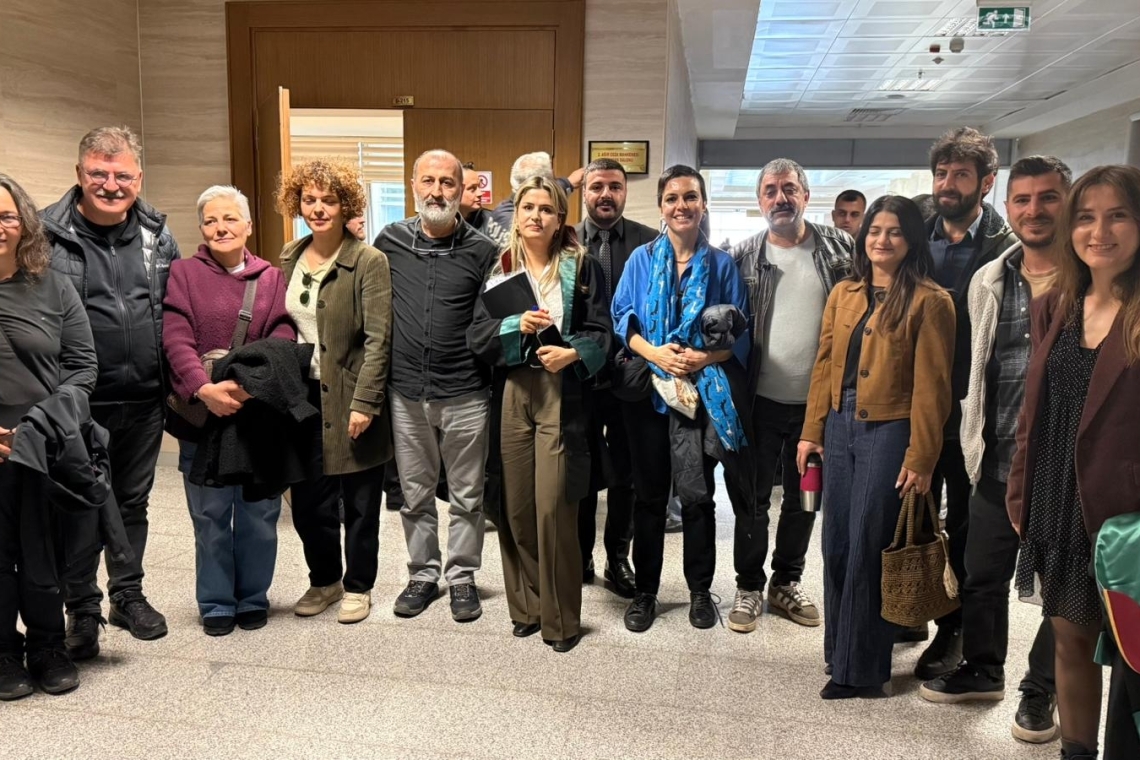
- Koray Kesik, the cinematographer of the Bakur documentary, appeared before a judge on the charge of “making propaganda for an organization”; Kesik said, “I wanted to bear witness to history.”
- At the end of the hearing, the court lifted judicial control measures and the ban on leaving the country.
Metin Yoksu
The hearing of the case in which Koray Kesik is being tried was held at the Batman 2nd High Criminal Court. In the case, in which MLSA undertakes his defense, Kesik is being tried on the charge of “making propaganda for an organization.”
Kesik and MLSA Legal Unit lawyer Emine Özhasar were present at the hearing. Members of the Human Rights Association (İHD) Batman branch, producer Ayşe Çetinbaş, artist Nazmi Kırık, representatives of the Middle East Cinema Academy, and cinema workers from Istanbul and Ankara also attended for solidarity.
The hearing began with identity identification
Then the judge asked Kesik how the documentary was planned, and the defense statements were made.
Kesik said he is a documentary cinema worker, 55 years old, and has worked in the sector for about 30 years. He stated that he has taken part in more than 60 documentary works and has worked with many directors in Turkey. He drew attention to the fact that he has been involved in documentary projects concerning many nations and various professional groups, from the Aegean to the Black Sea and especially Kurdish cities. Kesik said he has also shot music videos, commercials, and public service announcements, adding that all of this is part of his job.
Answering the judge’s questions about his relationship with the directors of the Bakur documentary and the planning of the documentary, Kesik said: “One day Ertuğrul Mavioğlu called me and made an offer for cinematography. I got excited. Because bearing witness to history excited me. This is the logic of documentary cinema. Çayan Demirel is also a very well-known director; I also shot his ‘No. 5’ documentary. In 2013 there was a climate of peace. The state’s official agencies and channels were broadcasting from Kandil. Naturally, I did my job like them. This documentary was shot with the observational documentary technique. We did not direct anyone, and there is no voice-over. There was no text either. Everyone’s daily life was recorded.”
Responding to questions about his social media posts, Kesik said: “Many years have passed. I attended Newroz and May Day events. Due to my job, I filmed crowds. I did not specifically film any flag or banner. Just as when you go to a concert or a festival, crowds are filmed—the logic here is the same,” and ended his defense statement.
Then lawyer Emine Özhasar, in her defense statement, read the definition of documentary in the Turkish Language Association (TDK). Özhasar continued as follows:
“According to the definition of documentary, it is to tell realities. The Bakur documentary is also a documentary and does this. The Bakur documentary tells a bleeding wound of Turkey. My client also did the cinematography. He wanted to bear witness to history. No one can deny this: in 2013 there was a peace process. In a process where even the leader of the MHP says ‘let Abdullah Öcalan come to parliament and speak,’ will every journalist and documentary filmmaker who recorded these be tried 13 years later? Should a documentary filmmaker who recorded Hitler’s war crimes be tried for doing his job? In 2025 a weapon-burning ceremony was held. Many politicians, bureaucrats and officials followed it. Will there be a retrial 13 years later? Law cannot be shaped according to the political atmosphere.”
Özhasar also drew attention to the fact that 48 people in her client’s HTS records have criminal records, which should not even be the subject of an indictment. She said: “Who are these people? What cases do they have, have they been concluded? We know that judicial inquiry cannot be made in people’s social relations. No one has a judicial inquiry system at hand. People do not look at this in their social relations. Even if they are criminals, people can meet with anyone. There are also Constitutional Court decisions regarding banned books found at home; even if a book is banned, even if the person knows it, keeping it at home is not considered a crime. This is the Constitutional Court’s decision.”
Özhasar requested acquittal for her client and the lifting of judicial control measures.
After the defense statements, the court panel took a short break. After the break, the panel announced its decision, lifting the judicial control conditions and postponing the next hearing to May 7.
About one hour after the hearing ended, upon lawyers notifying their schedule conflicts to the clerk and the judge, the hearing was postponed to May 12.