

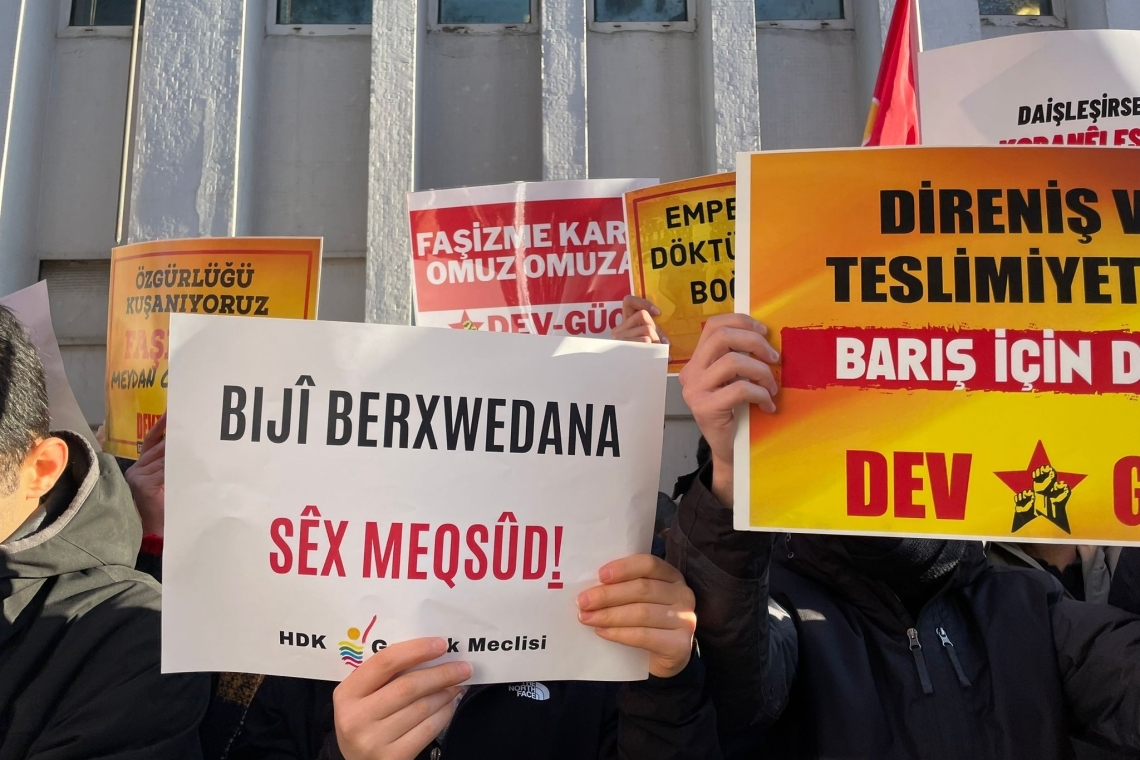
- At the first hearing of the case opened against 6 students, 4 of whom were arrested, on the grounds that they protested the attacks in Aleppo and Rojava at Istanbul University Beyazıt Campus, 4 students were released. It was also decided to lift judicial control measures for two students.
- In a letter they sent through their lawyers before the hearing, the students held in Marmara No. 6 Prison in Silivri described the torture and ill-treatment they experienced in prison.
Rabia Çetin
The first hearing of the case opened against 6 students, 4 of whom were arrested, on the grounds that they protested the developments in Aleppo and Rojava on Jan. 9, 2026, at Istanbul University Beyazıt Campus was held. Of the 6 students tried on charges of “unlawful meeting and march,” “insisting on not dispersing,” and “publicly inciting to commit a crime,” a decision of release was given for Emir Sağlam, Doğukan Mağol, Hamit Akay and Yunus Emre Öksüz. It was decided to lift the judicial control measures regarding Barış Süleymanoğlu and Berzan Bağatarhan. The case was postponed to July 3.
After identification, Barış Süleymanoğlu, one of the arrested, who made the first defense statement said:
“We gathered to make a press statement regarding the massacre in Rojava. However, the police took us under blockade without making any warning to disperse. They started to take into custody. I did not chant any slogans. I did not get involved in any scuffle, I did not resist the police. We only used our constitutional right,” he said. Berzan Bağatarhan also stated that he is innocent and requested acquittal.
Doğukan Mağol, who started a hunger strike as of March 6 due to allegations of torture and ill-treatment in prison and ended his strike on March 27, claimed that the group was taken under blockade during the protest and that they were taken into custody without warning. Mağol stated that during the incident one person attacked the group and that he tried to help a friend. Emir Sağlam argued that the action was within the scope of constitutional right. Hamit Akay and Yunus Emre Öksüz also stated that they did not resist the police.
Speaking on behalf of all defenders, lawyer Okan Acar said that the action was a press statement and that the claim that a march was carried out does not reflect the truth. Acar stated that the police showed the place where the statement would be made and that the students made the statement here.
Lawyer: a criminal complaint should be filed against the person making the grey wolf sign
Acar stated that a person named Efe Güler provoked the environment by making a “grey wolf” sign during the incident and that the scuffle occurred after this provocation. Defending that no warning was made in the direction of dispersal, Acar expressed that his clients used their constitutional rights within the scope of Law No. 2911. Acar also requested from the court that a criminal complaint be filed against Efe Güler.
In the defense statements, it was emphasized that no organizational propaganda was made in the action, no slogans were chanted and no weapon or similar material was found. Acar stated that the detentions and arrests were “unjust and disproportionate” and requested acquittal.
After the defense statements, the prosecutor, whose opinion on the merits was asked, requested the continuation of the detention of 4 students and the elimination of deficiencies.
Announcing the decision, the judge decided on the release of Emir Sağlam, Doğukan Mağol, Hamit Akay, Yunus Emre Öksüz, and on the lifting of the judicial control applications regarding Barış Süleymanoğlu and Berzan Bağatarhan, and postponed the hearing to July 3 at 14:00.
Allegation of torture in prison
The students arrested on Jan. 10 were first sent to Metris Prison. Then they were sent to Marmara No. 6 Prison located in Silivri. One of the students, Doğukan Mağol, conveyed the torture and ill-treatment they experienced in prison in the following words in the letter they sent through their lawyers:
“We stay 10 people in rooms for 6 people and some of us have to stay in the common area. We sleep in that area, change our clothes, eat, etc. We spend most of our day in that area. There is also a camera in that area that monitors and records 24/7. We told everywhere that the camera violates our private area and that it should be removed. However, the administration management did not accept our request by presenting various excuses. In response, we decided ourselves to close the camera and we closed the camera.
The next day (March 6) a group of 30-35 guards entered the ward and tried to forcibly take the friend who closed the camera to the cell. Because we objected to this, they also attacked us. I was taken by being beaten for minutes and dragged on the ground from F-3 ward to a cell in B-6. Bruising, peeling and injury occurred on various parts of my body.
I was kept for three days in a cold cell without shoes, barefoot and without a coat-cardigan. At the end of three days, my clothes were brought to the cell. I started an indefinite hunger strike on March 6. The wounds that occurred on my body: a wound on my eyebrow, wounds in 6-8 places on my throat, peeling on my left elbow, a bruise on my left groin, bruising on my left back, a bruise on my right groin, bruising on my left back, peeling on my left toe, bruising on my right waist, peeling on my left waist, there is redness on my wrist.”