

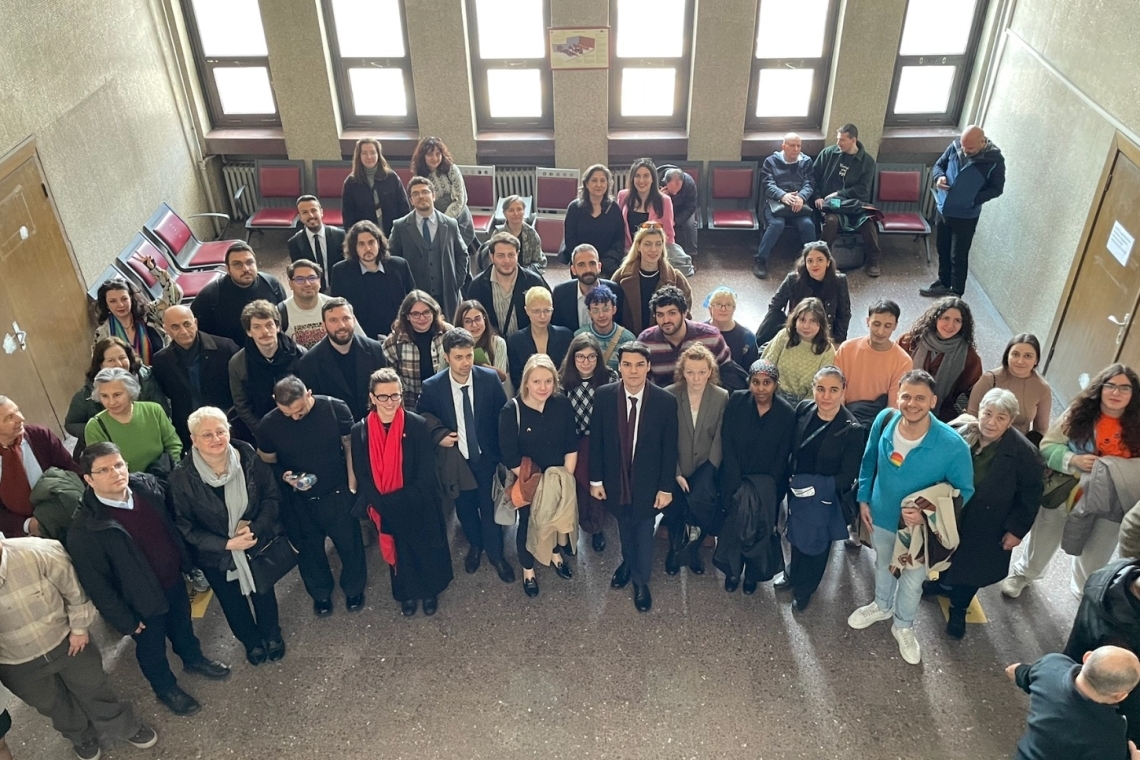
The court has issued an acquittal decision regarding Council of Europe Youth Delegate Enes Hocaoğulları, who was on trial on the charge of “inciting the public to hatred and enmity.”
MLSA - The second hearing of the case filed against Council of Europe Youth Delegate Enes Hocaoğulları on the charge of “inciting the public to hatred and enmity” was held at the Ankara 86th Criminal Court of First Instance. The court ruled for Hocaoğulları’s acquittal.
The hearing was monitored by representatives of the European Union (EU) Delegation as well as the embassies of Norway, the Netherlands, France, Sweden, Finland and Switzerland; representatives of Amnesty International and Go For; the Istanbul Bar Association Human Rights Center, the Human Rights Foundation of Turkey and LGBTI+ associations, along with activists.
In his defense statement, Hocaoğulları stated that five and a half months had passed since the first hearing. “In my first defense statement, I said that my detention prevented me from practicing my profession; I returned to my job. I travel abroad and participate in diplomatic events,” he said. Stating that diplomats referred to him as “the young person arrested because of his speech at the Council of Europe,” Hocaoğulları said, “The number of people who heard about the human rights violations I described in a hall of a few hundred people reached millions together with the smear campaign carried out and my arrest.”
Describing the process of being taken to Sincan Prison, Hocaoğulları said, “I was taken to prison in the steel compartment at the back of a vehicle. I was kept waiting outside for a long time. When I asked for water, the staff said, ‘It will be jinxed inside,’ and laughed.”
Stating that he spent the first night in an isolation ward where there were insects, Hocaoğulları said, “The only things that passed through my throat were dry bread and tap water.”
Saying that during the 15 days he stayed in the ward he was asked not to speak to anyone and not to lift his head, Hocaoğulları said, “A plastic chair was placed for me under the stairs and I was told not to get up from there.” He stated that in the ward to which he was later transferred, he was subjected to physical contact by a prisoner.
Emphasizing that he was not recounting what he experienced “to create agitation,” Hocaoğulları said, “After my release, I experienced panic attacks. I am seeing a psychologist. I am receiving treatment for my spine and my eye.”
Regarding the judicial control measure against him, he said, “It is not hurtful because signing once a month is tiring, but because it is unjust. I request the lifting of judicial control.”
The court ruled for Hocaoğulları’s acquittal as a result of the trial.