

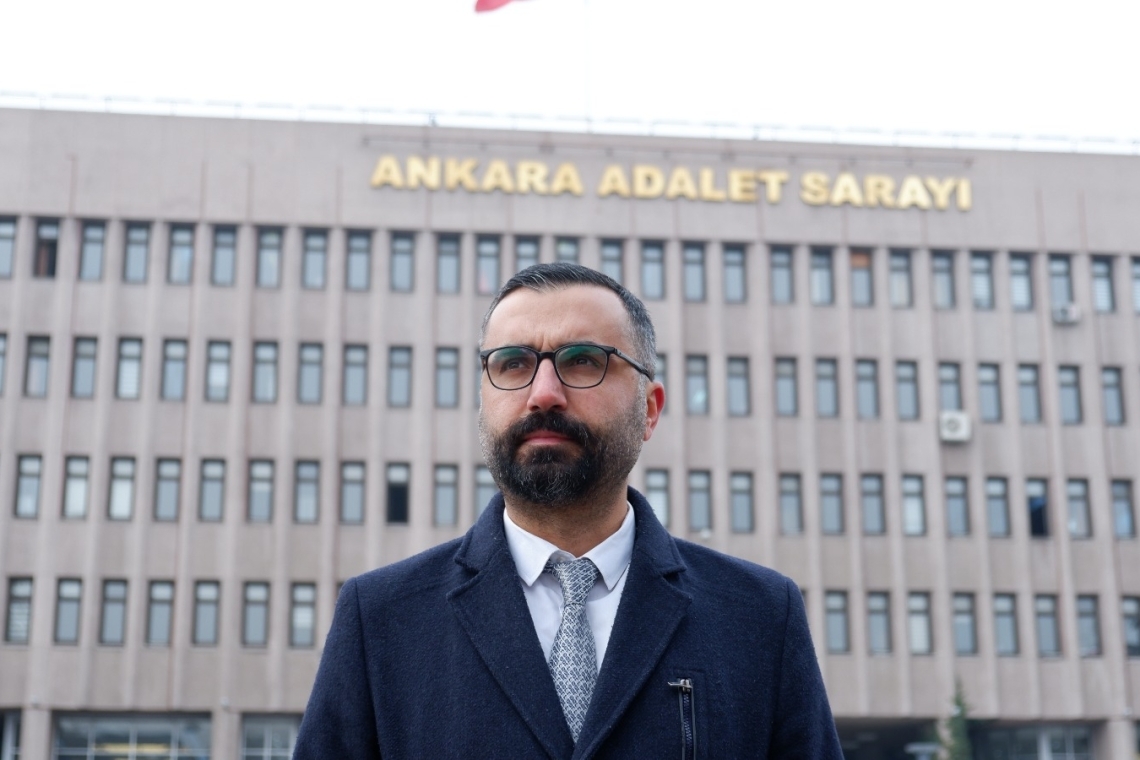
Photo: Batu Bozkürk
- The investigation against journalist Alican Uludağ was launched after a social media post he made on Feb. 19.
- Later, 22 separate posts from 2025 were added to the file; the date and scope of the alleged offense were changed.
- Although it was argued that Ankara had jurisdiction, the investigation was conducted in Istanbul and by a terrorism prosecutor.
- In the arrest decision, “risk of flight” and “risk of tampering with evidence” were cited. However, no concrete grounds were shown for these justifications.
Semra Pelek
The process leading to the arrest of journalist Alican Uludağ began with a social media post he made on the morning of Feb. 19. Uludağ’s lawyer, Abbas Yalçın, said there was no legal basis for conducting the investigation in Istanbul and that the file contained numerous problems concerning the right to a fair trial.
1. The investigation began with the Feb. 19 post
At 10:00 a.m. on Feb. 19, Uludağ shared a post quoting a press statement by the Bakırköy Chief Public Prosecutor’s Office. The statement included findings regarding links between certain public officials and an organization known as the “Casperlar,” in an ongoing investigation.
Quoting the statement, Uludağ added his own assessment, saying that mafia-type structures consist not only of members but that politicians, bureaucrats and members of the judiciary can also act together with such structures.
Following this post, an investigation was launched against him under Article 301 of the Turkish Penal Code (TCK) for the offense of “insulting judicial bodies.” Prosecution of this offense is subject to the permission of the Justice Ministry. On the same day, the ministry granted permission to investigate.
Eight days before the investigation was initiated, Akın Gürlek had been appointed as Justice Minister by President Recep Tayyip Erdoğan. Gürlek had previously served as the Istanbul Chief Public Prosecutor.
2. Earlier posts were added to the file
According to Yalçın, after it became clear that the investigation could not proceed solely on the basis of the Feb. 19 post, 22 additional social media posts from 2025 were added to the file.
This time, the accusations were based on Article 299 of the TCK (insulting the President) and Article 217/A (publicly disseminating misleading information).
However, in the referral letter requesting arrest, the date of the alleged offense was stated as Feb. 19, 2026. Yalçın said this was incorrect, noting that all the posts forming the basis of the “insulting the President” charge dated from 2025. He said the most recent post was made about four months ago, while some dated back a year.
Yalçın added that during this period no complaint had been filed by the President’s lawyers, and prosecutors in Ankara had not launched any investigation regarding these posts. “For a year, no complaint was filed by the President’s lawyers. Prosecutors in Ankara also did not open an investigation into these posts. Despite this, an ex officio investigation is launched in Istanbul, and moreover by a terrorism prosecutor,” he said.
3. The investigation was conducted in Istanbul and by a terrorism prosecutor
Nevertheless, the investigation was initiated ex officio in Istanbul and handled by a terrorism prosecutor. Lawyer Yalçın said no terrorism-related charge had been directed at his client, yet the file was handled by a terrorism prosecutor.
“We asked the prosecutor: ‘Why are we before a terrorism prosecutor? Is our client accused of a terrorism offense?’ No, there is no terrorism accusation. Despite this, the file is being handled by a terrorism prosecutor,” he said.
Yalçın said the justification given for conducting the investigation in Istanbul was that the President’s residential address is registered in Istanbul. “For a President who spends most of the year in Ankara and carries out his duties from there, this justification is not a legal explanation,” he said.
4. ‘All the posts are based on his reporting’
Yalçın stated that all of Uludağ’s posts were based on his news reporting, judicial decisions and official statements.
“When asked which post is misleading or which contains an insult, no concrete answer can be given. We have not seen any insult in any of these posts,” he said.
5. Grounds for arrest: Risk of flight and tampering with evidence
Uludağ was detained at his home and taken to Istanbul. Yalçın said that during questioning before the judge, Uludağ stated, “I do not even apply for a visa. So that it is not said that I fled, I do not even obtain a visa.” Despite this, he was arrested on the grounds of risk of flight.
Yalçın said the arrest decision cited risk of flight and risk of tampering with evidence. However, he noted that all the posts subject to the accusations were already included in the file and that there was no other evidence.
6. ‘The arrest is unlawful’
Yalçın said they would object to the arrest decision. He added that even if the detention continues, it would be possible for the execution of the sentence to be carried out in Ankara, noting that Uludağ’s wife and two children live there.
“This investigation should never have been opened. This arrest should never have happened. But even if it were to happen, it should not have happened in this way,” Yalçın said, adding that they consider the procedures carried out to be unlawful and that they will pursue all legal remedies.
In his statement, Uludağ said, “I have never lied to the public. I did my job properly. I will not take a step back from this, I will not remain silent.”
Legal framework: Jurisdiction, arrest and freedom of expression
Jurisdiction and the principle of the natural judge (Criminal Procedure Code Articles 12-13)
Under the Criminal Procedure Code, investigations are, as a rule, conducted by the prosecutor’s office where the alleged offense was committed. Determining jurisdiction in a controversial manner may raise issues regarding the guarantee of the natural judge and the right to a fair trial.
Proportionality of arrest (Criminal Procedure Code Article 100)
Arrest is an exceptional measure. Suspicion of flight or tampering with evidence must be based on concrete facts. Otherwise, a claim of violation may arise in terms of the right to liberty and security of person (Article 19 of the Constitution, Article 5 of the ECHR).
Freedom of expression (Article 26 of the Constitution, Article 10 of the ECHR)
Journalists’ criticism on matters of public interest is protected under freedom of expression. Any interference must be lawful, pursue a legitimate aim and be necessary in a democratic society. In the case law of the European Court of Human Rights, it is stated that criticism directed at persons exercising public power enjoys broader protection.