

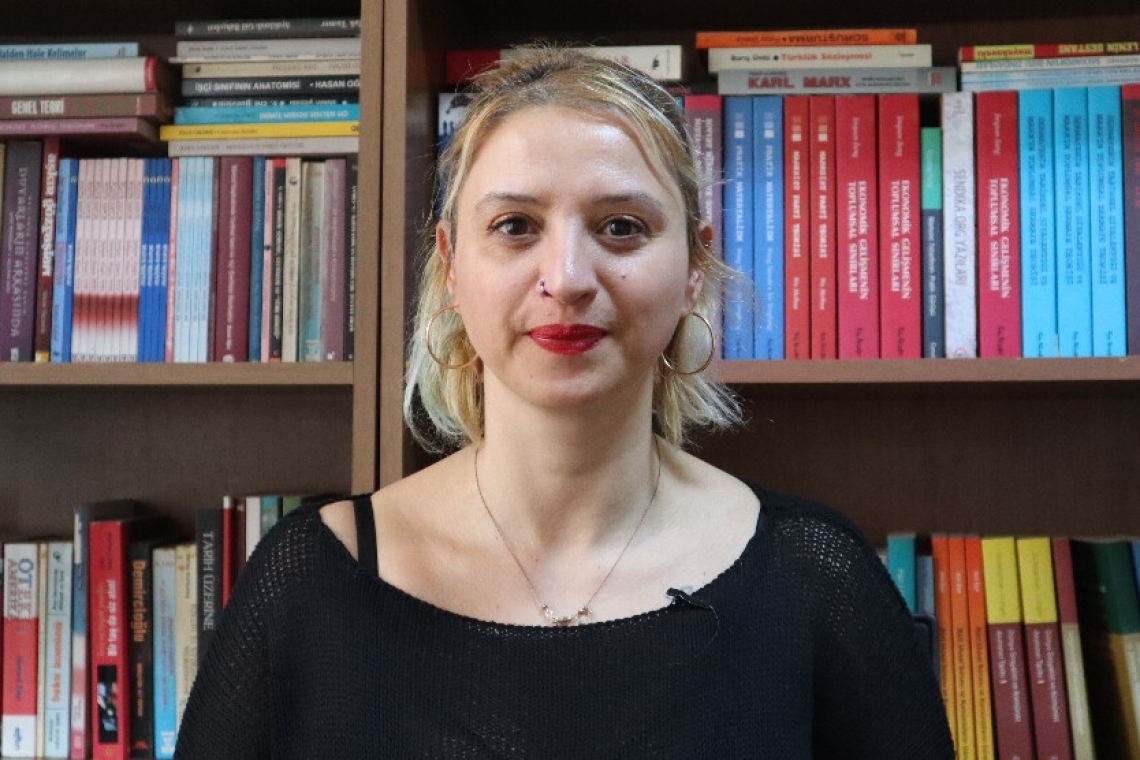
- Most of the accusations directed at detained ETHA reporter Pınar Gayıp stem from routine journalistic activities such as covering court hearings, monitoring funerals, conducting interviews and communicating with newsrooms, according to a case review by Emine Özhasar, head of the MLSA Legal Unit.
- Even Gayıp’s attendance at the funeral of Emine Ocak — a symbolic figure of Turkey’s Saturday Mothers/People movement — being photographed with a camera around her neck and small money transfers of 100 Turkish lira (about $3) have been made subjects of investigation.
- Gayıp, who has been in pretrial detention since Feb. 5, rejected all accusations during her questioning before a judge, stressing that all activities in the file fall within the scope of her professional routine as a journalist.
The Media and Law Studies Association (MLSA), which has undertaken her defense, said in a written legal opinion prepared by Özhasar that the charges against Gayıp largely consist of journalism-related work. Özhasar emphasized that treating court and protest monitoring, funeral coverage, use of cameras, contact with a newsroom and small money transfers as elements of a criminal investigation amounts to the criminalization of journalism.
Below is a summary of the questions raised in the investigation file and the circumstances of Gayıp’s arrest, based on Özhasar’s review.
Who is Pınar Gayıp and where is she now?
Pınar Gayıp is a journalist working for ETHA, a left-leaning news agency in Turkey. According to the case file, she has been detained since Feb. 5, 2026. During her questioning before the court, she identified herself as a journalist. She is being held at the Bakırköy Women’s Closed Prison in Istanbul.
What is she accused of?
According to her police statement, Gayıp faces accusations of “membership in an armed terrorist organization” and “making propaganda for a terrorist organization,” two charges frequently brought in terrorism-related cases in Turkey.
What happened during her police questioning?
The file states that on Feb. 4, 2026, Gayıp was questioned at the counterterrorism branch (TEM) of the Istanbul Police Department. She did not answer the questions and exercised her right to remain silent.
What did she say before the judge?
During her Feb. 5, 2026 questioning at the Istanbul 9th Criminal Judgeship of Peace, Gayıp said she was covering news events, that she holds a press card and that ETHA is being portrayed as “illegal.” She argued that the agency carries out legal procedures and pays taxes.
What was asked based on a “confidential witness”?
The file includes statements from a confidential witness identified by the code “M4L1T2P5Z3,” dated April 24, 2021. According to this testimony, the witness alleged that Gayıp gathered information “in the field” and published it on ETHA’s social media account. Police questioned Gayıp about her activities at ETHA on the basis of this statement.
How were witness and “confessor” statements used?
Some statements in the file allege that Gayıp works for ETHA, is in contact with certain individuals or was identified from photographs. In parts of these testimonies, phrases such as “I know/learned” are used, while other sentences draw limits, such as “I do not personally know her, but …” Despite such qualifications, the language of the questions posed to Gayıp assumes she holds an “organizational position.”
How is “court hearing monitoring” treated in the file?
A phone conversation in the file shows Gayıp discussing whether detained individuals had been released and to what date a hearing had been adjourned. This conversation was turned into one of the topics for which police sought an explanation during questioning.
How were funeral and commemoration events addressed?
The file states that Gayıp was recorded at certain commemoration and funeral events and that she was “acting together with the group.” In particular, her attendance at the funeral and commemoration of Emine Ocak was raised with questions such as “Why did you attend?” and “Who gave the instruction?”
Ocak was a prominent member of the Saturday Mothers/People, a group that has held weekly vigils in Istanbul since the 1990s to demand accountability for relatives who disappeared in custody during years of political violence.
Why is her use of a camera included in the file?
During her court questioning, Gayıp noted that the file contains images of her with a camera around her neck while covering news events. In the investigation file, such images are evaluated within discussions of her “participation” in certain events.
Why were small money transfers such as 100 lira questioned?
The file also includes reports from Turkey’s Financial Crimes Investigation Board (MASAK) detailing Gayıp’s bank account activity. Small money transfers she made to people around her — for example, amounts of 100 lira — were included and questioned with regard to their purpose.
Overall assessment
According to the legal review, the file places many elements of what could be considered a journalist’s daily professional routine — following courthouse developments, monitoring funerals and commemorations, taking photographs, maintaining contact with a newsroom and making small money transfers — at the center of criminal interrogation.
Before the judge, Pınar Gayıp rejected all accusations and maintained that these actions constitute journalism.